Saturday, September 04, 2010

Cochiti Lake Offers Great Escape for City Dwellers

It may be just down the hill from Santa Fe, or right up the road from Albuquerque, but for many visitors to Cochiti Lake, it’s a world away from the hustle and grind of the big cities.

“And those who haven’t been here in a while should be pleasantly surprised by the many improvements we’ve made,” says Mike Carey, manager of the lake for the US Army Corps of Engineers.

Visitors will find a brand new campground featuring attractive shelters with modern picnic tables, barbeque grills and solar powered lamp posts. There’s also water, electricity and improved access for today’s larger recreational vehicles at many sites.
Camping is $12 a night at the new campgrounds 16 primitive sites while another 16 with water and electricity are $20. There’s a 14-day limit on staying in the campground, reservations can be made at www.recreation.gov while many sites are set aside for use on a first-come, first-serve basis. 

The new campground is part of $13 million overhaul of the lake’s facilities with even more campsites and a bathhouse with showers slated to open in the spring of 2011, Carey says.

Down on the lake’s beach and swimming area visitors will find new shelters where swimmers can get out from under the sun after enjoying a dip in the cool waters fed by the Rio Grande. 
And with family budgets tight these days a trip to Cochiti Lake can be refreshing in more ways than one, visitors aren’t charged a “Day Use” fee as is typical at many other federal and state recreational areas.

Pets are prohibited from the beach area but welcome while leashed in all other areas of the lake. Alcohol, glass bottles and firearms are not allowed at the lake. Only gas and charcoal grills can be used, no campfires, and anyone using any kind of floatation device such as an inner tube must also be wearing a lifejacket.

There are no concessions at the lake and visitors should be prepared for their outing with all necessary supplies. Some groceries and fishing tackle can be found at stores in Pena Blanca.

Cochiti Lake is a Mecca for windsurfers and sail boats due to its gentle but continuous breezes and many of the colorful craft can be seen out on the lake among other types of boats.

Cochiti is a no-wake lake, motorized boats are allowed but are restricted to idling speed, and there is a boat launch fee of $3 per day or $30 for an annual pass. The lake has two boat launches, one on either side of the lake.

The west side of the lake features the facility’s upgraded visitor center with informational displays, restrooms and offices. Here visitors will also find a scenic overlook and access to the road atop the dam which can be hiked or biked but is off limits to motor vehicles. 
The west side of the lake is where one will find the new campground and access to the beach and swimming area.

The east side of the lake is called the Tetilla Recreation Area and features more camping and picnic sites, another scenic overlook and a boat ramp and access to the shoreline along Santa Cruz Road. This area is popular among fishermen, windsurfers and those seeking greater solitude for swimming and recreational activities.
A visit to the east side of the lake requires visitors to turn off State Road 16 at Tetilla Peak Road and head towards the village of La Bajada and continue for about ten miles down a remote stretch of two lane blacktop bordered by vacant Indian lands. 

Anglers will find bass, crappie, catfish, sunfish, walleye, pike and some trout in the lake and a state fishing license is required. More information about current fishing conditions can be found online at www.wildlife.state.nm.us.

Rangers begin locking up the gates starting around 6 p.m. but anglers can park outside and walk back in to fish during the more productive evening hours. 

Despite its proximity to Santa Fe and Albuquerque, Carey says he doesn’t expect the lake to be overrun with visitors this long holiday weekend.

“We’ll be full but it won’t be as intense as Memorial Day when everyone’s itching to get out after a long winter,” he says.

Carey, 63, of Placitas, retired several years ago after a 40-year career with the Corps but returned to manage Cochiti Lake after the assigned manager, Rebecca Miner, was deployed to Afghanistan to work on public building projects.

The agency has seen many of its employees sent overseas to assist in building projects in Iraq and Afghanistan and has been relying upon retirees to voluntarily step back in and help out, Carey says.

“After three years of retirement I was looking for a little excitement anyhow,” he says.

So while the rest of the world hits the road and heads for the hills this long Labor Day weekend, Cochiti Lake, awaits those looking for something a little closer to home but seemingly miles away. 
If You Go: From Santa Fe take I-25 south to the bottom of La Bajada and take the turn off at the overpass to Cochiti Lake on St. Rd. 16. From Albuquerque do the same. To get to the east side of the lake take Tetilla Peak Rd off St. Rd 16 at the turnoff to the village of La Bajada. 
For the west side of the lake, continue west on St. Rd. 16 past the Tetilla Peak turnoff and follow down to St. Rd. 22. Go right and follow to the lake. If coming from Albuquerque and headed for the west side of the lake then one can get off I-25 at the Santo Domingo exit and follow St. Rd. 22 through past the pueblo and through the village of Pena Blanca and on to Cochiti Lake.


Thursday, August 19, 2010

Canero Guard Station a Welcome Respite from Hectic Summer Tourist Season

There’s a reason much of southern Colorado might feel like home to many New Mexicans.

Maybe it’s because so many of the same Spanish settlers who colonized New Mexico went on to do the same in places like the San Luis Valley, where a Spanish/Mexican land grant fueled much of the area’s development.

Taking a drive across our northern border today reveals many of the familiar scenes related to Hispanic settlement of the region, including iconic churches, a farming and ranching culture and weathered faces peering out from under straw hats.


But one might be surprised to discover that the first Anglos to settle in the valley were Mormons who established the town of Manassa, birthplace of the great heavyweight fighter Jack Dempsey, and also hometown of current Secretary of the Interior, Ken Salazar.


And the area’s agricultural base has drawn many Amish and Mennonite farmers who now can be seen traveling by horse-drawn carriage along back roads or frequenting the town market, clad in their distinctive, handmade clothing.


Bordered on the west by the San Juan Mountains and towns like Antonito and Del Norte, the valley extends east to the Sangre de Cristo mountains and the oldest town in the state, San Luis, founded by New Mexican settlers from the Taos and Mora areas in 1851.

To the north one will find the funky little town of Saguache and one of the state’s easiest mountain passes to cross at Poncha Pass. To the south the valley flows just across the state line into northern New Mexico before fading to high country desert around Tres Piedras.

The primary route north through the center of the San Luis Valley is U.S. 285 while the main east and west highway is U.S. 160.


While traveling through the area one might be interested to know that many of the valley’s farms produce much of the barley used to brew Coors beer. It is also home to the headwaters of the Rio Grande, whose waters nourish New Mexico, and, it is the location of one of the largest, solar powered, electric power plants in the country.

It’s also where the National Forest Service maintains a number of remote cabins for rent where visitors can relax in simple comfort while enjoying the vast array of recreational activities found here.


For more info and reservations go to www.recreation.gov and check under cabins/lookouts in Colorado.

A recent stay at the Carnero Guard Station in the Rio Grande National Forest revealed a secluded two- room cabin featuring propane heat and lights, hardwood floors, comfortable bunk beds, and a fire ring and picnic table in the front yard.


The surrounding forest is dotted with rolling hills and pastures highlighted by amazing volcanic rock formations.


Guests at the guard station are just a short drive from Penitente Canyon, where rock climbers now flock to once what was a spiritual hideaway of the secretive religious brotherhood.

Visitors to the cabin will find numerous forest roads to explore with many leading to intriguing places where wildlife can be seen, fish caught and relaxation found.


The uniqueness of the area is its lack of highly popular and heavily used recreational sites, which allows visitors to enjoy a greater degree of solitude even during the peak of the summer tourist season.

Those using the cabin as a base can make any number of day trips to local attractions like the town of Saguache where while visiting the historic downtown district one might catch Saguach Cresent Editor and Publisher, Dean Coombs, putting out what is perhaps the last newspaper in the country produced by a Linotype, hot lead, printing machine.


Saguache even features a theatre where visitors can catch a movie over the weekends as well as a fine town park in which one can lounge on the grass in the shade of many towering trees.

Day trips in the area could include a visit to the Great Sand Dunes National Park with perhaps an evening in a pool at any of three hot springs resorts found nearby. There’s an alligator farm and UFO watchtower to be investigated and a church in San Luis where bronze sculptures depicting Christ’s Stations of the Cross lead up a hillside to a church with twin spires.

Back in the woods, fishing can be found on any number of small creeks running through the forest, but the best might be had just off Highway 114 on the drive over to Gunnison.

Flowing through a canyon, Cochetopa Creek, holds wild brown and brook trout and anglers can stop at any number of roadside pullouts to bust through the streamside brush and fish for them.

Continuing down the road, anglers will find fishing available, with permission, on private ranches, such as Kreuger’s, which is stocked with fish by the state.

Kreuger’s Ranch features almost idyllic water flowing through scenic pastures with plenty of ox bows, undercut banks and good cover for fish. The ranch offers cabin rentals and RV parking too.

And maybe the best part of a visit to the San Luis Valley might be a stop at the no-name, burger joint on the outskirts of Antonito that features green, chile, cheeseburgers that rival anything found in New Mexico.


If You Go:

From Santa Fe, head north on U.S. 84/285 through Espanola and follow to where the route splits at the turnoff to Ojo Caliente and Antonito.
Follow U.S. 285 north through La Jara and Monte Vista towards Saguache. 
After passing through the turnoff to Center watch for the La Garita turnoff at Road G. Follow to Forest Road 41G, about 17 miles to the cabin. Gas, beer, groceries, food and the cabin key can be picked up at the La Garita Trading Post.


Sunday, August 01, 2010

Ghost Ranch's Piedra Lumbre Visitor Center Worth Stopping For


The Piedra Lumbre Visitor Center off U.S 84 near Abiquiu Lake provides travelers of this wonderfully remote, incredibly picturesque, stretch of blacktop, a unique opportunity to stop and learn more about the land they’re passing through.

“We’re isolated,” says Ghost Ranch’s Director of Museums, Cheryl Muceus. “But there’s plenty to see and do once you get here.”

Operated by the nearby Presbyterian Church’s Ghost Ranch Education and Retreat Center, the visitor center features two informative and interesting museums, a fabulous gift shop and jaw-dropping views of the backcountry that inspired renowned artist, Georgia O’Keeffe.

The facility was formerly operated by the Forest Service as a living museum featuring wildlife too injured to be returned to the wild. The operation was forced to close in July 1999 after animal rights activists complained about the conditions.

The Forest Service then hoped to reopen the facility as a visitor center to cater to outdoor recreational enthusiasts and others traveling northward to Chama and Colorado.

However those plans never materialized and it remained closed until 2005 when Ghost Ranch stepped in to reopen the facility under a lease with the Forest Service.

Ghost Ranch operates and maintains the facility and its exhibits and pays a nominal leasing fee to the Forest Service for its conditional use.

“But we would like to obtain the property either through an exchange or outright purchase someday,” Muceus said.

Ghost Ranch could then make facility improvements and program changes that would better suit its needs in educating travelers and directing them to its other operations at its nearby 21,000 acre education and retreat center.

This cabin found off the entrance road to Ghost Ranch was used in the filming of the 1991 movie "City Slickers". 
The Ghost Ranch features paleontology and anthropology museums, spiritual and other educational programs, housing and related services and all sorts of activities. For more information see its website at www.ghostranch.org. 

In the meantime, though, the Piedra Lumbre, or shining rock, visitor center provides travelers with a welcome stop on the long, lonely road to Chama and beyond.

Visitors will find a well-stocked, unique gift shop featuring among other things a great selection of postcards featuring local scenery and landmarks. There’s also what seems to be the entire collection of Nevada Barr and Tony Hillerman novels, as well as other books and items available for sale.

The store also features cold soft drinks, ice cream and some snacks too.

Entering the grounds, visitors will find a nicely done rendition of a traditional, northern New Mexico, adobe building, the Gateway Museum, featuring vigas, latillas and a comfortable, aspen-shaded courtyard to rest in.


Inside are displays and exhibits dedicated to local Indian cultures, local sheepherding and weaving and the Spanish land grants that once dominated the area.

In another building, the Pack House, visitors will find more information about the original founder of the living museum from whom the Forest Service had obtained it, Arthur Pack.

It was Pack who sold O’Keeffe a summer home on the ranch from which she drew much of her artistic inspiration. The artist also established a winter home in the village of Abiquiu and later moved into Santa Fe where she died at the age of 99.

Here in the Pack House one will also find a great selection of preserved insects and other regional wildlife including skulls, furs and displays. There’s an informational display about the beavers that were once prevalent throughout the area, another about the life of aspens, a wildflower exhibit and displays dedicated to the Cumbres and Toltec Railroad and the mining industry, too.

The visitor centers grounds are also the site of the smallest National Forest in the country, the Beaver National Forest surrounded by an oasis of aspens on this high desert property. 


But it may be the surrounding scenery around the visitor center that truly captures one’s attention, as soaring vistas and cloud-studded skies draws one’s eye to the horizon.

One can make a short climb up to an elevated, observation deck on the grounds to take in the surrounding view while inside there is a display of prints dedicated to O’Keeffe.

A binder on hand contains pictures of the surrounding countryside and O’Keeffe’s work that shows how the scenery of the valley inspired many of her works.

Visitors to the area will also find nearby other interesting stopping points such as Echo Amphitheatre, Abiquiu Lake, the Monastery of Christ in the Desert and the Perdenal, the flat topped mountain that overlooks the entire area. 


Monday, July 26, 2010

Floating the Lower San Juan River - Big Browns, No Crowds, Great Fishing !

Tim McCarthy shows off a nice brown trout from the lower San Juan river.

It’s eight and half miles of glorious water loaded with big, bad, brown trout that most anglers visiting the San Juan River pass up on a regular basis.

Many have seen this lower stretch of river from the road as they motored up to their favorite fishing hole on this famous river’s, quality waters.

And with so many fish to be had upstream, an estimated 70,000 in four miles of public access, many don’t even think about fishing down below.

After all, you’d need a boat and some high water to easily float downstream to those fabled browns.

But that’s just what we did when we set out to explore this lower river on a midsummer expedition to the lower waters of the San Juan River.

The flows on the river this summer were kicked up to around 950 cubic-feet-per-second for a few weeks to supplement lower flows from the Animas River so a minimum flow could be maintained downstream for endangered fish.

Taking advantage of the higher water was drift boat owner, Tim McCarthy, of Albuquerque who is also the author’s brother-in-law. Our guest for the day was Soaring Eagle Lodge owner, Larry Johnson, who frequently guides on the lower river and was happy to be taken fishing for a change.  

Johnson noted that during higher flows the lower river is easier to navigate and the fish less spooky and more spread out. 

Johnson was cautiously optimistic about our chances for success but sure seemed to be grinning a lot. 

Larry Johnson of Soaring Eagle Lodge.

We put the drift boat in at the state game and fish department ‘s access point just below the town of Navajo Dam, off San Juan County Road 4277, next to the Rainbow Lodge.

We then took the truck and trailer downstream to the game and fish’s “take out” area just above the Hammond diversion dam.

The take out can be found by taking a right onto a dirt road at the top of a hill just off State Road 511 about a half mile shy of U.S. 64. The road is unmarked save for a skinny green post, bearing a thin, red placard with the numbers 5367, in white, running down it.

One might want to familiarize themselves with the area first on Google Earth, then inquire at a fly shop for local directions and finally do some scouting around before hauling a trailer down there.

The unimproved, dirt road may be impassable when wet and is steep and rutted at some points.

After dropping off the truck and trailer we climbed into our second vehicle and headed back upstream to begin our day-long trip.

We’d lucked into incredible weather as the day began cool and overcast after a week-long, record breaking, heat wave had gripped the area.

The monsoon season was now just beginning, it had rained the night before and it was forecast to do the same again later today.

Johnson suggested we rig up one of his green, woolly boogers sporting rubber legs, a cone head and a trailing hook. He said just chuck it over towards the banks and strip it back with a series of short, quick retrieves. 

The deadliest booger.

This proved to be the fly and the technique for the day as we didn’t see a rising fish or a good hatch the entire float. 

Swapping off on the oars, we all took turns chucking the green monsters at the ledges, edges and green water, producing attacks from a steady supply of eager brown trout. 

The key to hooking them was to keep the lure moving, the rod tip low to the water and setting the hook with a quick strip of the line.

It was exciting to see from the vantage point of the boat, the lure threading its way through then water and then the flash of a fish as it came out of hiding to attack it.

We caught a steady supply of browns in a variety of sizes, verifying what game and fish department surveys by electro shocking had already proven, a lot of healthy, brown trout live in these lower waters.

“There’s no doubt about it, there’s some good sized fish down there,” says Marc Wethington, the state Department of Game and Fish’s fisheries biologist stationed on the river. “And they don’t get the pressure you see upstream.”

And that resulted in some great acrobatic displays as many a surprised brown jumped and fought like one might normally expect from a Rainbow trout.

The trip downstream took about six hours with some brief rain showers and overcast conditions during the morning and then sunny and much warmer during the afternoon.

We were well equipped with raincoats, wide-brimmed hats, sunscreen, insect repellent and plenty of cold water and snacks, thus, we didn’t suffer much. 

Larry Johnson mans the oars while Tim McCarthy casts during a recent outing on the lower San Juan River.

We discovered the river flows through some spectacular country as we passed through canyons hemmed in by towering sandstone cliffs, shot through with layers of faded red and tan rock.

Overhead crows, buzzards, eagles and hawks circled and cried.

At other times we found ourselves hemmed in by thick rows of pale, green and very thorny, Russian Olive trees. Here the bugs seemed thick and the air alive with their buzzing.

As the rookie driver on board, I was constantly warned to stay away from the bank and its thorny trees.

At one point I was also scolded for letting the boat do a lazy, midstream, doughnut as I peered up at the beautiful banks of fluffy, flat bottomed clouds overhead.

Just goofing around, like a kid in an inner tube.

We then came across the idyllic, riverfront home of Abe Chavez, founder of the legendary Abes Motel and Fly Shop at Navajo Dam.

And around another corner we discovered a pretty, little, red and white trimmed, ranch house with a wide expanse of green lawn and a “for sale” sign posted out front.

That got us all buzzing.

The river continued past a pasture stocked with cattle and horses and a grove of shady cottonwoods under which sat a couple of old kitchen chairs and a forked stick stuck in the sand.

Someone’s own, backyard, fishing hole.

What a life, we all agreed.

There were spots that begged further investigation but down here you don’t drop anchor or get out of the boat for fear of trespassing on someone’s land, and maybe, getting shot at, Johnson warned us.

It’s a good policy designed to ensure good relations with the neighbors, he says.

We continue to fish and float, picking up a bruiser hidden behind a log lashed to pile of old automobile grills buried in the bank for erosion control. A dog rushes to the bank growling and barking excitedly as we reel in yet another monster brown. 

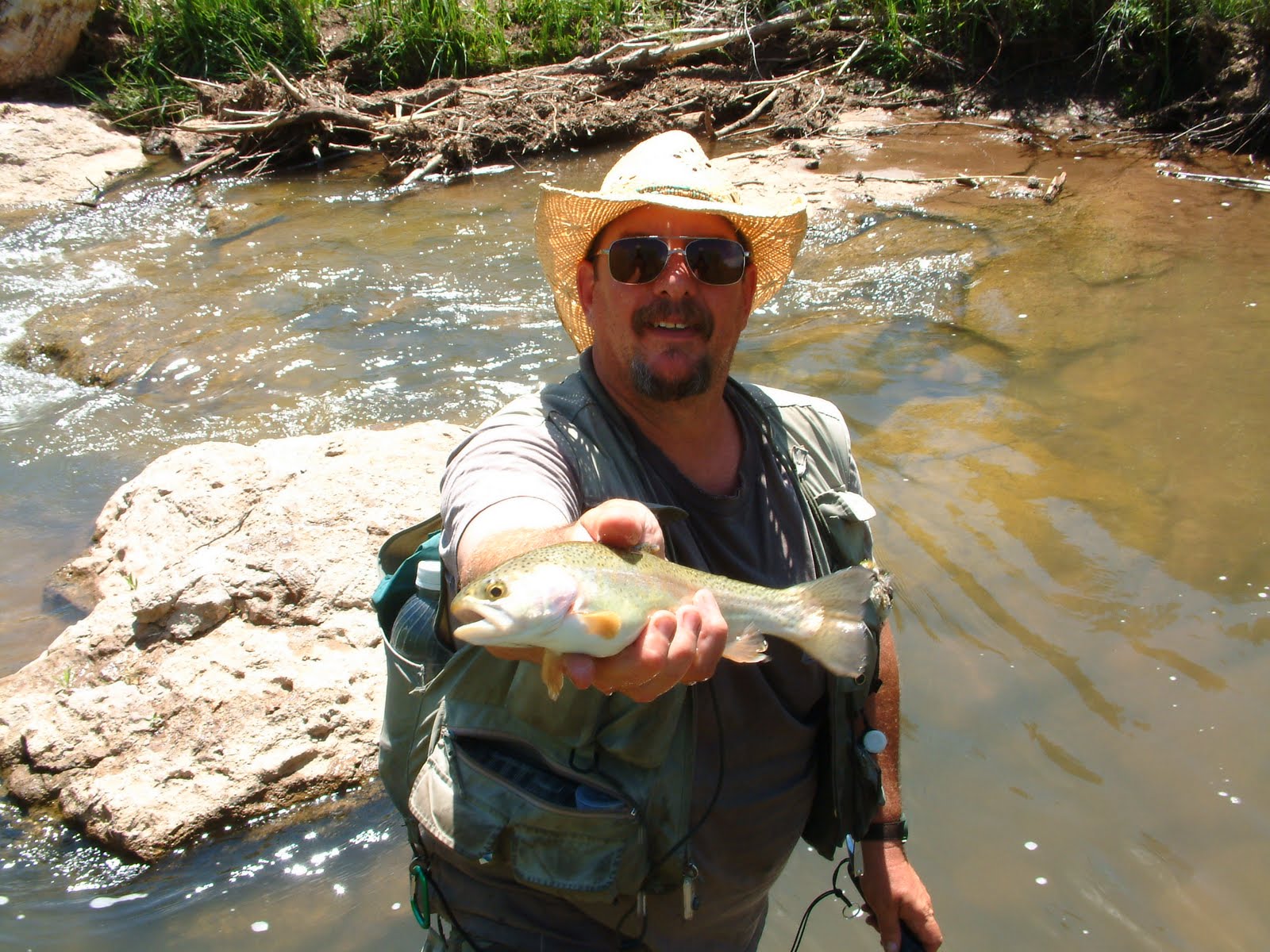
Karl Moffatt shows off a nice brown picked up in the lower stretch of the San Juan River. 

And then we’re there, in the long slow water leading up to the diversion dam, alerted to its location by the big rock in the middle of the river and an island behind it that splits the current in two.

Johnson warns that we don’t want to miss the take out hidden amongst the thick trees or we might get swept downstream where we’ll have hell to pay dragging the boat back upstream, by hand, in the extremely cold, water.

We find it and bury the nose in the sandy bank, jumping out and slapping high fives all around, it had been an excellent day on the water, with great company and even better fishing. 

We saw just one other boat with a guide and a single angler on board that whole day.

Back at Cottonwood Campground as we sit under the picnic shelter, guzzling cold beers and grilling fat t-bones, our elderly neighbor stops by to inquire about our luck that day.

I showed him the pictures and he exclaims “Where’d you get those.”

All I can do is smile and say “downstream.”


Wednesday, July 21, 2010

Fly Fishing the Pecos National Historical Park. Check It Out!


It’s a little piece of the Pecos River where one can find a clean, quiet, pleasant place to dabble a fly for trout this summer.

The Pecos National Historical Park’s pilot, fly-fishing program is underway for its third year, playing host to anglers seeking a quality experience while chasing trout in the river located just a short drive from Santa Fe.

This picturesque, three-mile stretch of water that runs through the national park defies the upper Pecos River’s widely held reputation among many anglers as one of the most overrun, trashed out and used up fisheries in the state.

But for a price, an angler can get away from the rowdy crowds, noisy campgrounds and extensive litter that can be found on many public stretches of the Pecos River located in the Santa Fe National Forest above the village of Pecos.

The program was started in the fall of 2008 to address public demand for access to nearly three miles of river running through about 3,300 acres of the park’s land that is still off limits, said Christine Beekman, spokesperson for the 6,610-acre park.


Since then the program has gained a following amongst a core group of regulars, she said. But while many anglers might make reservations to fish the river, quite a few also fail to show up, making it possible for walk-ins to take advantage of open slots.

The program utilizes a reservation system and divides the river into three beats, two of which are dedicated to reservations and a third which is open to walk-ins on a first-come, first-served basis. No shows’ slots are made available to walk-ins after 9:30 a.m.

Beats are randomly rotated each day to provide variety to users and each beat is limited to a total of three anglers per day. The cost is $25 for the day with a $3 park entrance fee. The $25 covers the cost of running the program and grants the user a special use permit for access to the closed portion of the park.

Fishing on the river is catch and release only with single barbless hooks and anglers must present a valid New Mexico fishing license upon check in. No pets or commercial guides are allowed and the river is off-limits if the stream flow meets or exceeds 200 cubic feet per second. 


The summer season runs through Aug. 2nd and the fall seasons begins Sept. 2nd and runs through Oct. 25th. For more particulars about making reservations and other information go online to www.nps.gov/peco and click on the 2010 fishing program tab. Or call the park at (505) 757-7200.

As part of the fishing program, anglers are asked to fill out a questionnaire about their experience when checking out. Then information will be used as part of the park’s evaluation of the program and plans for future use, Beekman said.

The park’s management is expected to begin taking public comment this coming winter to determine how to best use the rest of the park, including the river, she said.

The park’s management plan will be guided by the public’s right to access and the government’s need to protect the resources, Beekman said.

A recent visit to the river revealed solitude and spectacular scenery as expected but challenging fishing due to the heat.


The lengthy hike to the beginning of beat two or further on to the bottom of beat three requires some stamina while wearing waders under a blazing, hot, summer sun. It also cuts into the time available for fishing, a serious consideration during the summer months due to the limited amount of time available to fish under current rules. Anglers are restricted to fishing from 8:30 a.m. to 4:30 p.m. during the summer program.

A visit to the river revealed that it could have easily been fished in sneakers and shorts and that would have been a lot more comfortable while hiking in and during wading.

Suggestions on how to improve the program to better suit anglers will be entertained during upcoming public meetings and comments will also be collected online, Beekman said.

It’s possible that the river and surrounding park land could be open to the public by next spring, she said. 


And while the fishing at the Pecos National Historical Park might be a great reason to visit the park, its museum, Indian ruins, the remains of an early, Spanish church, a civil war battlefield and its Forked Lighting Ranch house are all equally worthy reasons for a visit to the park, Beekman stressed.

The park’s museum features one of the more comprehensive and detailed history of the region, while the Indian ruins feature a cool, underground kiva to hide out in on a hot summer day. 


If You Go: 

Take I-25 out of Santa Fe towards Las Vegas and get off at the Pecos/Glorieta exit at State Road 50. Drive into town and take a right at the stop sign and intersection of State Road 63. Follow for a couple of miles to the visitor center entrance. Some fishing supplies, licenses and beer available at Adelo's Store. Good burgers at the village drive-in located a couple of blocks up the road from Adelo's on the other side of town, headed towards the national forest.


Popular Posts