Saturday, April 28, 2012

Star Gazing Best at Clayton Lake State Park

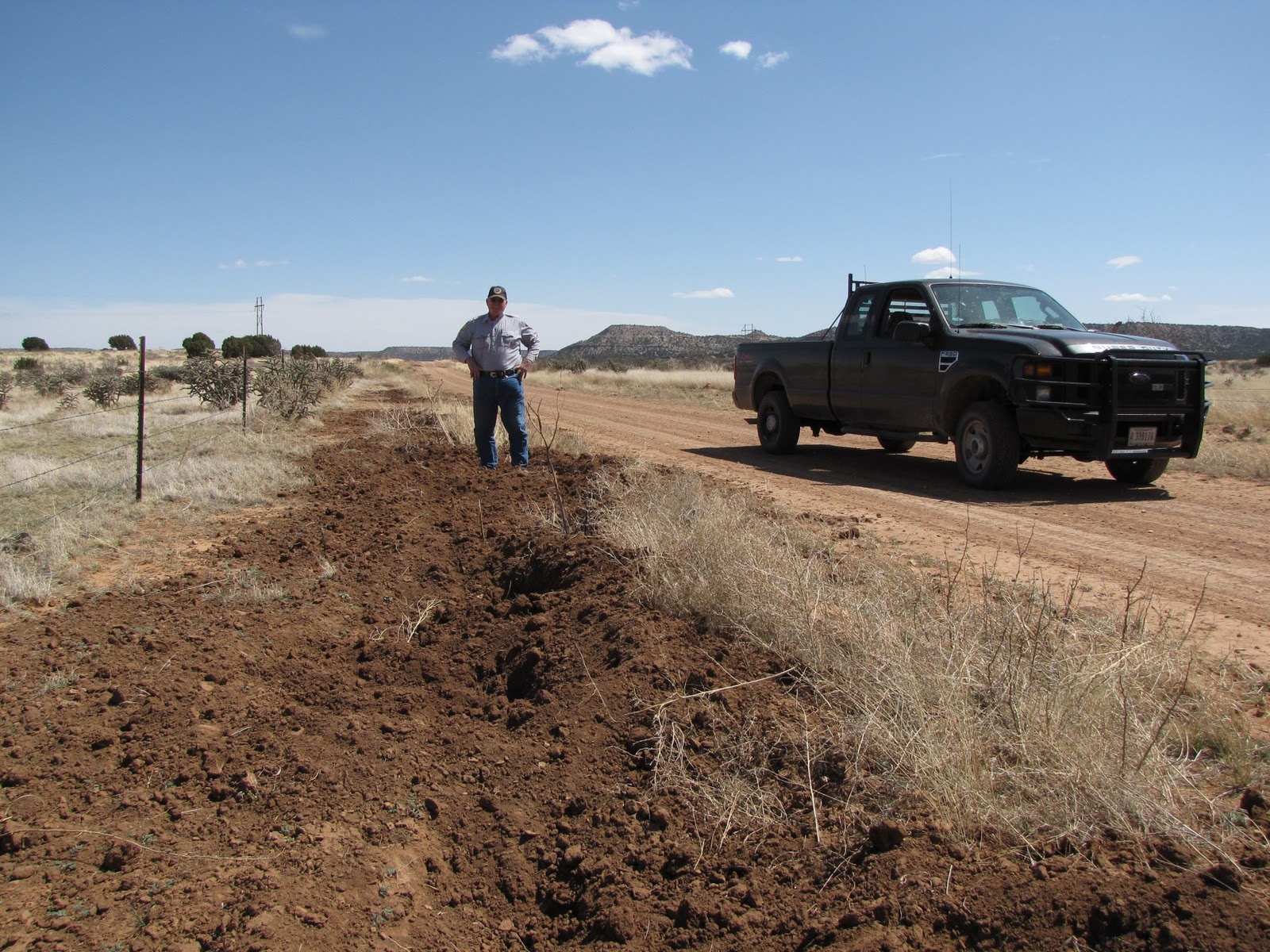
The road to Clayton Lake State park.
If you’re looking to see stars, then forget Santa Fe’s Plaza and get out to Clayton Lake State Park where they throw parties for them all the time.

Boasting some of the best star-gazing conditions in the country the park is only one of four worldwide that is officially recognized for its incredibly dark skies.

“The conditions there are top notch,” says Scott Kardel, Director of Public Affairs for the International Dark Sky Association. “That puts them in a very exclusive club”

The Association bestowed its top honor upon the park in June 2010 for its efforts to preserve the dark skies, reduce surrounding light pollution and provide educational programs.
Photo courtesy of  Bosela & MorgueFile.
And that recognition couldn't have come without the support and assistance of the local community, says Peter Lipscomb, former Director of the New Mexico Heritage Alliance’s Dark Sky Program and now a Regional Interpretive Ranger for NM State Parks.

“It’s a real feather in their cap,” Lipscomb says of the 3,000 residents of Clayton and those of surrounding Union County who passed light pollution ordinances to help preserve the area’s dark skies.”That shows you just how supportive they are of that observatory.”

The state park is located about 12 miles outside of the neat, little town of Clayton where cattle ranching on the surrounding plains remains king and the cowboys are for real.
On the eastern plains of New Mexico cattle ranches dot the endless landscape.  
Charles Jordan, 51, has been manager of the park out on the plains for the last 19 years and he says the observatory is a great asset made all that much greater because of the volunteers from the local astronomy club.

“They’re a great group of people and we just couldn’t do it without them,” Jordan says.
Clayton State park Manager, Charles Jordan, shows off the park observatory's 12-inch Meade computer operated telescope. 
The club hosts regularly scheduled star parties each month on the first Friday of the new moon cycle while also providing impromptu parties for visitors when the park has plenty of overnight visitors.

Hundreds of local school children of all grades have also visited the observatory under a “No Child Left Inside” initiative between the park and local school district.

And numerous scouting groups, astronomy clubs and campers have all enjoyed the benefits of the observatory, says Art Grine, 49, president of the Clayton Astronomy Club and the town barber.

“We’ve got people coming from all over the country to do astronomy here now,” he says. “And we’ve all come to appreciate just how special our night skies really are.”
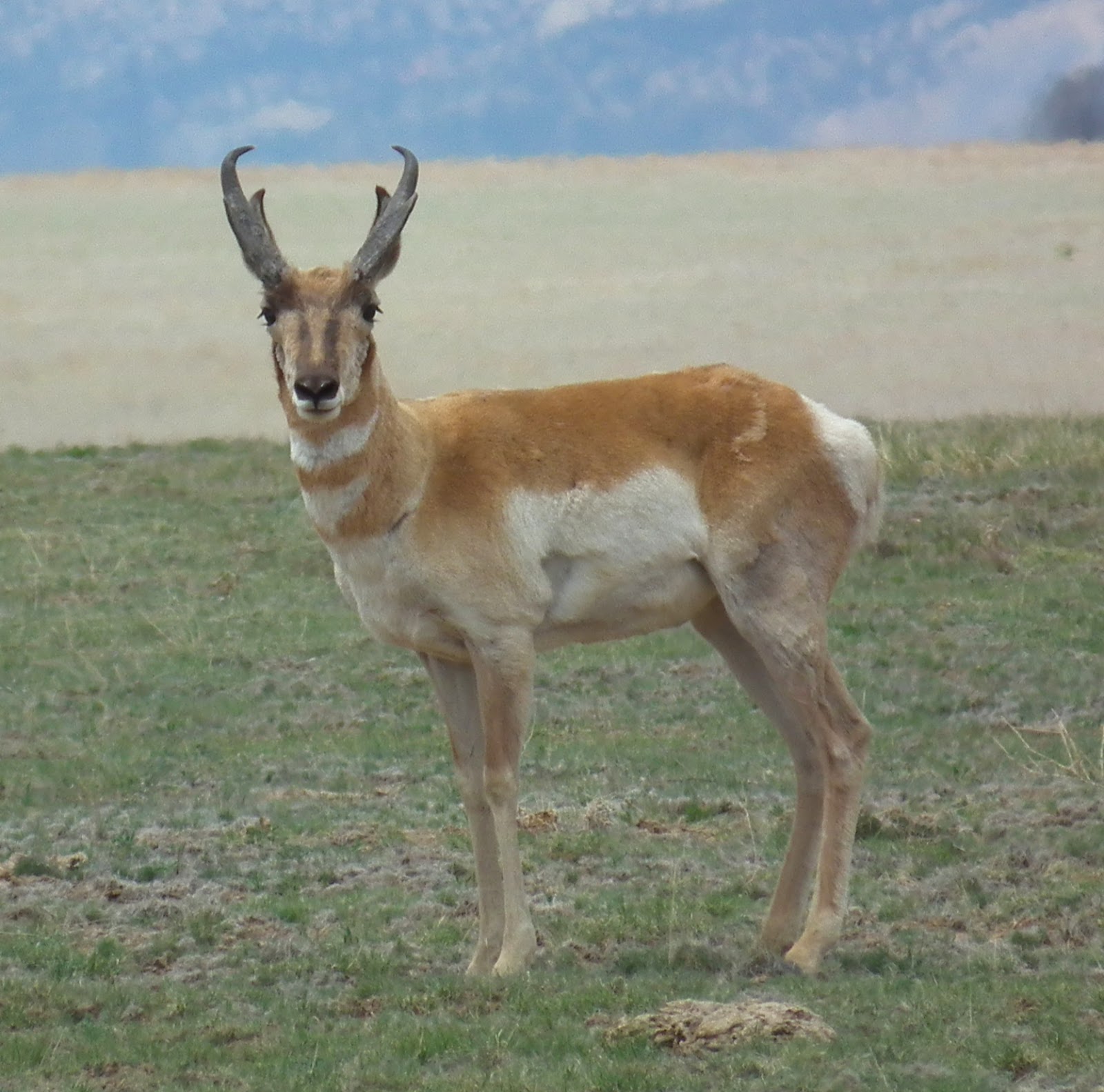
Pronghorn can frequently be seen roaming the plains of eastern New Mexico. 
Grine notes how great it is to see a young kid gush upon seeing the rings of Saturn through a telescope for the first time.

“It’s totally awesome to see,” he says.

It was the same for him when he first went out to the park on a field trip with his son and his junior high school class many years ago and saw Saturn through a telescope for the first time.

And now he’s the astronomy club’s president.

The park’s $75,000 Star Point Observatory opened in June 2006 and features a 12x16-foot building with a retractable roof that houses a 12-inch, computer operated telescope and remote television monitor which allows for group viewing.

The telescope and monitor is powered by a solar charged battery system.

The club also has several additional 8-inch telescopes that its volunteers set up on concrete pads outside the building which allows other guests to observe selected targets in the night sky too.
The Clayton Lake State Park observatory.
The observatory is NM State Park’s second to be constructed with the first having gone up several years earlier at City of the Rocks State Park in the southwestern corner of the state, according to Dave Gatterman, Bureau Chief of Design and Development for the state agency.

The agency would like to construct two more when finances become available, one in the northwest corner of the state at Heron Lake State Park and another at a yet to be determined location in the southeast quadrant of the state, Gatterman says.

Clayton Lake State Park and the local astronomy club will also entertain private groups. Anyone interested in making use of the observatory, camp sites or group shelters at the park can contact them by phone at 575-374-8808 or by email at charles.jordan@state.nm.us.

In addition to the observatory, the park is well known among anglers for producing record sized walleye as well as good sized bass, trout and bluefish.

The lake currently holds the state record for a walleye caught in 1989 by G.L. Peppers that weighed in at 16-lbs and 9-oz and measured over 32-inches in length.
Former NM Dept. of Game and Fish Conservation Officer, Kelly Dobbs, shows off a record breaking walleye discovered in Clayton lake State Park in 2010.
The park also enjoys a good reputation among bird and wildlife watchers and those interested in paleontology as a large set of dinosaur tracks were found and are now preserved in the earth that forms the dam’s spillway.

The park also features a new visitors’ center constructed of straw bale and recycled steel beams and while utilizing the latest in green energy techniques.

The visitor center also features an interpretive display inside which highlights the park and surrounding area’s history and other interesting information.
Clayton Lake State Park's state of the art, environmentally friendly, visitors center.
The park boasts over 30 campsites equipped with shelters, picnic table and fire rings.

There are seven sites with electric and water hookups and two large group shelters.

Showers are available inside the main restroom while numerous vault toilets are located throughout the park.

The park’s boat ramp is currently closed due to low water levels because of the ongoing drought but fishing from the bank is easy and good.

A ranger lives on site to help maintain the park’s family friendly atmosphere and camping this time of year is especially enjoyable with warm days, cool nights and only light breezes.
Clayton Lake State Park features great fishing and camping, fabulous scenery and spectacular night skies.
The park will also host its 12th annual Trout Derby the weekend of June 9 and 10th featuring a grand prize of a fully equipped fishing boat in addition to cash prizes for top catches.

Door prizes will be given away all weekend long too and there will be a hotdog eating contest, childrens’ sand dig and a horseshoe pitching contest.

The annual event attracts about 5,000 visitors and is fast becoming one of New Mexico’s best homegrown attractions.

For more information about the fishing derby contact the park or the Clayton Chamber of Commerce at 575-374-9253 or on their website at http://www.claytonnewmexico.org

If You Go: Take I-25 through Las Vegas and turnoff at Wagon Mound onto NM 120. Follow through Roy and continue on this remote and lonely stretch of two lane blacktop to the intersection of US 56. Head east on US 56 to Clayton. Take NM 370 north out of town to the turnoff to Clayton Lake State Park. About 250 miles one way.
NM 120 between Roy and the intersection of US 56.

Friday, April 06, 2012

Great Bass Fishing So Close to Santa Fe and Albuquerque it Should be Illegal


Leo Salcido, 30, of  Albuquerque, shows of a nice, fat, bigmouth bass he caught  at Shady Lakes recently.
For over 50 years Shady Lakes in Alameda has been providing anglers a lush retreat where the thrill of battling a big bass is only a cast away.

Within easy striking distance of Santa Fe or Albuquerque the lakes are located off State Road 313 in the picturesque Rio Grande Valley just south of Bernalillo.

The park offers largemouth bass, bluegill, channel catfish and trout fishing under the shade of great cottonwoods and in the shadow of the nearby Sandia Mountains.

Anglers will find the native population of bass a worthy challenge and feisty fighters when hooked.

And you won’t need a boat or have to drive a couple hundred miles to get into them.

Kids will find the “easy catch” pond a great place to learn the sport while pursuing pan sized trout.

Those seeking a bigger catch will find 16-inch trout or larger lurking in the next pond over.

Trout anglers must keep what they catch here paying 62-cents-per-inch for some tasty trout.

And although the bass ponds are generally catch and release, anglers who wish to keep a fish caught in them may do so for the same per-inch fee.
The ponds at Shady Lakes just south of Bernalillo are brimming with  largemouth bass lurking  in the shadows.
But in celebration of their 50-year anniversary the per-inch fee will be reduced to just 50 cents during the month of May for those customers who mention this article and wish staff a happy birthday.

The offer is restricted to one time use per customer.

Shady Lakes has been a family business and local institution since 1962 when Jim Phillips made a realtor an impromptu offer of $40,000 to buy what was an 11-acre, bait-fish farm, says youngest daughter Jan Phillips, who now manages the operation.

“I think he was having a mid-life crisis at the time,” she said of her father who was a newspaper advertising executive then. “We had a nice house in the Heights and my mother, Joanne, just about divorced him over it.”

But the Phillips’ stuck together, bought the farm and moved into a small, three bedroom, and adobe house on the property. They then all worked very hard for many years to transform the farm into the successful business it is today.

“And it worked mostly because of our cheap child labor,” says Phillips who along with her two sisters, Jean and Jill, and two brothers, John and Jay, worked many long days on the farm.

“But we had a ball growing up here too,” Phillips says of the rural, agricultural setting on the fringe of Albuquerque’s north valley.

The property is bordered by the Rio Grande and the towering cottonwoods of the surrounding Bosque while farm pastures dot the neighboring landscape.

Phillips, a graduate of West Mesa High School, fondly remembers climbing trees; building forts and playing hide and seek with her siblings on the sprawling grounds of the farm.

“I was a bit of a tom girl then,” says Phillips, a tall, single, athletic blonde with a big, bright smile and a laid-back demeanor.
Jan Phillips of Albuquerque operates her family's longstanding  business , Shady Lakes  just north of Albuquerque.
The family’s first job in taking over the farm back then was to drain the ponds and convert the facility from ditch water to well water.

“We had some awesome mud ball fights then,” Phillips recalls of cleaning out the ponds to rid them of carp and sucker fish.

The use of cold, clean groundwater then allowed them to plant game fish and water lilies and stock trout all summer long, Phillips says.

“We now get folks who’ll stop here just to catch a trout for dinner,” she says.

Phillips, 54, has been managing Shady Lakes since 1989 and hopes to continue doing so for many years to come.

“I just can’t imagine this not being open and available to the public,” she says.

But before taking over from her parents who have since passed on, Phillips spent many years working as a licensed practical nurse.

Like her brothers and sisters she too had left home to pursue her own career and life.

She quit work for a while to earn a degree in graphics design and illustration and even took an epic, summer long, cross-country road trip in a Volkswagen minibus.

“That may have been the best thing I’ve ever done,” she says of the trip which included a 10-day backcountry canoe voyage with an Outward Bound program in Minnesota.

“Now that was an experience,” she says with a touch of disbelief in her voice.

Then there was the time she found herself stranded in incredibly remote Glacier National Park of Montana with a burnt out wheel bearing on the bus.

And there was the engine fire while visiting Dinosaur National Monument outside of Vernal, Utah.

Luckily she was prepared with a fire extinguisher on hand.

“It got pretty hairy sometimes,” Phillips says. “But it was a great trip.”

Phillips says she regrettably sold the bus after blowing the engine but still finds herself seeking adventure, most recently having gone sky diving during a mountain biking vacation in Moab, Utah.

Daniel Hayden, 30, of Albuquerque says the key to success in fishing at Shady Lakes  is the taking a day off once in a while and just getting out there.

But it was while working once again as a nurse in Denver during the late 1980’s that Phillips kept having a recurring thought about the family farm.

Was there a market for the abundance of water lilies that they cultivated in the fishing ponds back home?

She made a few calls to local nurseries and discovered that supplies of aquatic plants were scarce while demand was great, and getting greater.

“They were asking me if I knew where they could get them,” she says.

Phillips had stumbled into the onset of what was fast becoming the residential garden pond craze.

So Phillips hustled back home to help her Mom who was managing the business since her Dad had returned to work with the state.

So Phillips set to work and ended up shipping water lilies all over the country and today she grows a variety of aquatic plants to supply the market.

Shady Lakes also stocks everything needed to construct and maintain a residential garden pond including liners, pumps, filters, ornamental fountains and even frogs, goldfish and koi fish.

And while the residential pond supply business has been instrumental in the operations’ success, it is the fishing that still gives her thrills.

“When those lilies bloom and you know those bass are hiding under there it can be pretty distracting,” she says.

Bass love that kind of cover and will hide under the lily pads where a well placed cast of an artificial frog might elicit a ferocious strike, she says.

The park store stocks basic fishing supplies but most serious bass anglers typically bring their own including the many different and unique varieties of soft plastic lures, spinners and top water flies developed for bass.
Carissa Malanowski,34, of Albuquerque who works at Shady Lakes where one of the perks is the fishing shows off her private stash of bass lures.
Shady Lakes makes for a great fishing destination due to its abundance of fish, its nearby location and spectacular ambiance and scenery.

And a state fishing license is not required on the private waters at Shady Lakes.

Private fishing permits at Shady Lakes are $7.50 for trout ($5.50 for kids and seniors) and $10.50 for bass, bluegill or catfish.

For more information go to www.shadylakes.com. or give them a call at (505) 898-2568.

Karl F. Moffatt is a longtime New Mexico journalist and avid outdoorsman who can be contacted through his blog at www.outdoorsnewmexico.com

If You Go: From Santa Fe one can take the Rail Runner train and get off at the Sandia station or elect to drive on I-25 south to the Tramway exit, head west toward the river and at the traffic circle turn north on NM 313 and follow to nearby Shady Lakes.


Friday, February 10, 2012

Hunting & Fishing Show to Feature Local Bamboo Rod Builder

When the doors open and the crowds start to filter in at Bob Gerding’s annual hunting and fishing show this weekend, fledgling bamboo fly rod builder Bruce Smith of Edgewood will be there to realize his dream.

“It’s pretty exciting,” the retired master carpenter said during a recent interview at his modest work shop tucked away in the hills of southern Santa Fe County. “And I’d be lying if I didn’t admit I’ve had some butterflies in my stomach.”

Smith will be exhibiting over a dozen of his meticulously hand crafted bamboo rods at the show and providing information on the history, construction and use of split bamboo cane rods.
Bamboo rods are considered by many fly fishing purists to be the best an angler can use. They are said to provide smoother casting, a supple feel and better response when a fish is on the line.

Gerding’s 14th annual hunting and fishing show kicks off at noon on Friday and runs through the weekend inside the Manuel Lujan Center on the state fairgrounds at Expo New Mexico.

Exhibitors will include hunting and fishing outfitters, outdoor product vendors, educational seminars and other activities.

And this year the angling group New Mexico Trout will be holding its annual fly tying symposium featuring top fly tiers during the show.

The popular King Salmon fishing simulator will also be back this year too, says promoter Bob Gerding who is in 14th year of running the show.
Tickets are $8 and kids under 12-years-old get in free. For more info go to http://bobsoutadv.com/

Smith, in pursuing a career as a bamboo rod building career, is carrying on a family tradition of sorts.

Smith says his grandfather, Clyde Lester of Spokane, Washington, was a fisherman who liked to fix up old rods and reels in his shop when he wasn’t working construction.

“He was a gas to hang around,” Smith, 62, says of Lester whom his family often visited for vacation.

Lester worked with bamboo which was prevalent then as fiberglass and graphite rods had yet to hit the market.

“I was fascinated by his work and always dreamed of doing the same thing,” Smith says of those days hanging around with his grandfather who also taught him the art of fly fishing.

So when the economy tanked a few years back Smith finally got his chance to pursue his dream.

After 27 years of exclusively building stairs for construction companies like Pulte, Sivage and Stillbrooke Homes and also Accent Stairs in Albuquerque, Smith called it quits and got to work on his own small business.
His shop now features the tools of his new trade including specialized equipment he constructed himself for splitting and shaping the bamboo cane, wrapping, varnishing and drying the rods and other construction techniques.

Smith’s rods can be custom built to include gold plating, exotic wood rod handles, special paint schemes, carrying cases or whatever a customer may want to personalize their rod, Smith says.

Smith’s business venture is called Sweetrock Rodsmiths and in addition to crafting over a dozen rods for display at the show he has even built his own website which can been seen at http://www.sweetrockrodsmiths.com/.

And as far as Smith knows there’s only one other bamboo rod builder in the state that’s in the business.
Smith grew up in Albuquerque where his father, Clifford Smith, was a high ranking naval officer with the Naval Weapons Evaluation Command at Kirtland Air Force base.

Smith graduated from Del Norte High School in 1968 and set out to pursue his own career in the Navy serving as a machinery repairman with the Seabees.

But while on leave in Albuquerque in 1972 and preparing to travel to a new duty station in San Diego he was involved in an accident that drastically changed his life.

Smith got his vehicle stuck in a ditch on a country road while visiting friends and upon winching it out was severely injured when the cable snapped and nearly took off his leg.

His naval career came screeching to halt and his medical recovery took years to accomplish.

“There were no disability or insurance payments,” Smith said. “So I just had to suck it up and move on. The toughest part was learning not to be bitter.”

The accident left him with some serious emotional and physical problems to overcome and he came close to living off the streets at one point, Smith says.

But with the help of his family and friends Smith overcame those hurdles and went on to find a new career specializing in the construction of staircases, a specialty within the housing industry.

Smith is a long divorced bachelor who is still very good friends his wife, Karen, and they have a daughter, Kelsa, who is a graduate student at the University of New Mexico.

Smith’s father has since passed on but his mother, Jean, at 91-years-old is still well enough to have travelled on her own to visit family on the west coast over the holidays, he says.

Smith said that in making his debut at the hunting and fishing show Smith sees it as overcoming yet another difficult situation in life and moving on to a better place, something he hopes fellow vets returning from the Iraq war can accomplish too.


Tuesday, January 31, 2012

Wild Hogs Invade New Mexico & Threaten to Wreak Havoc

Wild hogs are invading New Mexico and are threatening to destroy the environment, spread disease and run off wildlife, according to authorities.

“This is a nightmare in the making," says Ron Jones, Wildlife Specialist for the Wildlife Services Division of the United States Department of Agriculture’s (USDA) Animal, Plant, Health Inspection Service (APHIS) in Tucumcari. “And we have a very slim window of opportunity to get a handle on this.”

Jones works on the front lines for the lead agency in the battle against the invasion of wild hogs.

“And our biggest problem right now is a lack of manpower and money,” Jones says.

The problem in New Mexico has grown from the discovery of a single incidence of wild hogs found in Quay county in 2006 to multiple confirmed cases in 12 eastside counties and three other counties in the Boot Heel region of the southwest corner of the state.
Wild hogs grow large, are aggressive and look like a domestic pig gone wild.
There have also been reports of wild hogs in several other counties but perhaps more importantly also in the Rio Grande valley, home to the Bosque del Apache National Wildlife Refuge and many species of wildlife.

Those hogs inhabiting the Boot Heel region are thought to be remnants of a longtime herd of escaped or released domestic pigs while most of those found on the eastside are thought to have been intentionally brought in and released for hunting purposes, Jones says.

Most feral swine are descendants of escaped or intentionally released domestic pigs while some thought to have come from wild boars that escaped from game parks.

Hog hunting has become a popular pursuit in New Mexico due to its lack of a season, requirement of a license and the unlimited harvest allowed.

But in an effort to stem the growth of the sport and its associated problems the state legislature in 2009 passed a law making it illegal in New Mexico to import, hold, release or sell feral hogs or operate a commercial wild hog hunt.

Wild hogs are not be confused with Javelinas, a native game animal, the hunting of which is regulated by the state Department of Game and Fish (NMDGF).

Adult Javelinas are much smaller, have straight not curved tusks and sport a white collar around the neck.
A Javelina is much smaller than a wild pig and is a regulated game animal.
Because wild hogs are classified as feral domestic livestock, not wildlife, state game and fish officers have no jurisdiction over them which is why the USDA’s Wildlife Service’s specialists, like Jones, are leading the charge.

And while some of New Mexico’s wild hogs are thought to have migrated into the state along the Pecos and Canadian river corridors from Texas, it has been their importation into the state for hunting that has really fueled their growth here, Jones says.

“These folks apparently don’t care about the damage they’re causing,” Jones says.

Texas is home to an estimated 2.5 million wild hogs that cause an estimated $52 million dollars in agricultural crop and related damage each year, according to Texas A& M research results.

Nationally the feral swine population has grown to an estimated 5 million in 35 states and they are estimated to cause about a $1 billion in damage each year, according to USDA APHIS data.
And due to the wild pigs ability to rapidly reproduce, up to two litters a year averaging at least six piglets per litter, they are multiplying at astounding rates.

Thus hunting as a management tool has proven to be almost inconsequential in reducing their numbers, Jones says.

DAMAGES CAUSED:

Wild hogs present many threats and their destruction of agricultural crops, predation of newborn livestock such as lambs and their capacity to uproot fields is well documented on websites such as Texas A&M’s found at http://feralhogs.tamu.edu/.

But it may be their potential to damage wildlife habitat, contaminate water supplies, spread disease and displace wildlife due to competition for natural resources that may be even more pressing for an outdoor recreational Mecca such as New Mexico.

“Habitat damage may be the bigger issue for us,” says Darrel Weybright, Acting Chief of the NMDGF’s Wildlife Management Division.

Weybright characterized wild pigs as being the new kids on the block competing with already established native wildlife populations for limited resources.

For example deer and bears rely heavily on acorn crops as a food base in New Mexico and wild hogs are known to have a strong preference for utilizing that same food source.

Hogs prefer acorns to the point that once they have depleted any source above ground they will then root out underground caches stashed by ground squirrels, pack rats and other animals.
Rooting effect of wild hogs.
The loss of such an important food base could have a potentially staggering effect on deer and bear populations which have limited alternative food sources to turn to in their absence, Weybright notes.

“So we certainly need to get moving on this and be smart about our approach in dealing with it,” he says.

Wild hogs have also been shown to carry numerous diseases, not the least of which is Pseudorabies, an affliction that can be transmitted through casual contact such as the simple touching of noses, says Jones, the federal wildlife specialist.

Consider the implications to wildlife if predators such as a pack of coyotes were to attack and kill an infected pig and then contract and spread the fatal disease, Jones says.

Over half the wild hogs killed during an eradication operation by wildlife specialists in Quay County in 2009, about 20, resulted in positive test for pseudo rabies, Jones said.

Jones questions whether the same scenario could also apply to other predators too such as bears, mountain lions and foxes that may also prey upon wild pigs, Jones says.

And the same disease transmission potential exists with livestock which feral swine come into regular contact while utilizing the same water and feed sources, Jones says.
Of particular concern to livestock operators would be a resurgence of other diseases the industry has worked hard to eradicate such as Brucellosis and Bovine Tuberculosis which the state’s herds have only recently been declared free of, says Dave Fly, State Veterinarian for the New Mexico Livestock Board.

“We’ve spent millions of dollars and over 20 years to become free if that,” he says. “We can’t afford to jeopardize all that work.”

Wild hogs are also notorious opportunists that prey upon newborn lambs, calves and even their vulnerable mothers which should be of particular concern to farmers and ranchers.

Calls to the Caren Cowan, Executive Director of the New Mexico Cattlegrowers Association seeking comment about the industry’s efforts to combat wild hogs were not returned. Nor were those made to the New Mexico Farm and Livestock Bureau.

Domestic livestock are not the only animals in nature that need to fear the influx of wild hogs.

Research has shown that the diet of wild hogs is heavily augmented - up to 60-percent- by the consumption of all sorts of wild animals including frogs, lizards, snakes, birds and their eggs and even deer fawn.

In one study at Fort Benning Ga. the stomach contents of one wild hog revealed 49 spade-foot toads that had been consumed in a single feeding.
A spade-foot toad. 
The study concluded wild hogs on the base were eating 2.8 million frogs and reptiles a year.

Of particular concern in New Mexico is the fate of endangered or threatened species such as the sand dune lizard in southeastern New Mexico where wild hogs inhabit 100-percent of the lizards’ habitat.

Of equal concern to those worried about the degradation of wildlife habitat is the spread of invasive noxious weeds that comes with the invasion of wild pigs.

Wild hogs are a crafty breed, says Tom Dominguez, the Quay County Extension Agent for New Mexico State University’s Cooperative Extension Service.

For instance, they need to wallow in mud to cool their bodies and fend off insects bites and they following account illustrate how far they’ll go to achieve that goal.

A rancher recounted to Dominquez recently about how he kept finding one of his stock tanks running over but couldn’t determine the cause.
New Mexico's east side has become a haven for wild hogs.
The overflowing water had turned the surrounding ground into a big mud pit and was also washing away the tanks’ foundation.

So the rancher hid and waited and soon saw a herd of pigs arrive.

Then he watched in amazement as one of the lead pigs climbed into the stock tank and found and held down on the tank float to keep the water flowing to create a wallow pit.

“They’re pretty innovative,” Dominguez said.

But snared within a wild pigs’ matted hair might be any number of invasive seed pods like the pesky Cocklebur, a plant which can be poisonous to livestock and horses.

Pigs wallow in the mud and coat the attached burs in a nutrient rich, fertile casing which then falls off while the pig roots, wallows or rubs against trees, one of their favorite activities.

Jones, the federal wildlife specialist, has documented where pigs had extensively rooted through pastures in search of grubs, tubers and earthworms. He then went back later to find the same pastures had grown over with weeds.

And in some cases these pastures may never return to their native state, Jones speculated.

Pigs also eat the seeds of many unwanted rangeland plants such as Mesquite trees and Cholla cactus. Some of those seeds are then passed whole in the pig’s feces and later sprout to further spread those plants reach.
Ron Jones, Wildlife Specialist for the Wildlife Services Division of the United States Department of Agriculture’s (USDA) Animal, Plant, Health Inspection Service (APHIS).
“It’s a vicious cycle,” Jones says.

And yet another threat wild pigs pose to wildlife and humans is the contamination of water sources such riparian areas, stock tanks and even municipal water supplies.

Wild hogs have been tested positive for carrying the potentially fatal strain of E-coli and were implicated in the notorious California spinach food poisoning case of 2006.

They have been found to carry the worst waterborne pathogens including Campylobacter, Salmonella, Cryptosporidium and Giardia.

And while wild pigs are incredibly adaptable, the one constant they must have is water.

Their frequent use many of the same watering sites as livestock, wildlife and even human water sources is a recipe for disaster due to the potential for disease transmission, Jones says.

“We’ve got a real problem on our hands here,” Jones warns.

WHAT CAN BE DONE:

It’s an early December morning and Jones is driving down a muddy ranch road heading for a high spot overlooking a canyon where he hopes to pick up a radio signal from one of his “Judas Pigs.”

“It’s one of the best tools we have,” Jones says as he bounces across a pasture and pull to stop on a butte overlooking a wide valley floor.

Jones pulls out what looks like an arm off a rooftop, television antennae and turns on the handset.

“Nothing” he mumbles before explaining how he suspects a hunter he had talked to recently had apparently gotten into the herd of wild pigs Jones had been tracking.

He was concerned that his Judas Pig had been killed and the $200 radio transmitter attached to it had been destroyed.

Wild hogs typically run in groups called “sounders” containing anywhere from 10 to 20 pigs and lead by a dominate female while male “boars” usually roam alone until visiting a sounder for mating purposes.
A corral cage with spring loaded saloon style doors to trap entire groups of wild hogs at one time.
The “Judas Pig” is usually a female that has been caught along with other members of her group in one of Jones many traps.

Her mates are euthanized but the Judas Pig is then released with an attached transmitter to find another group of wild pigs to run with.

Being highly social animals, the Judas Pig should lead Jones to her new group soon.

It is a very effective way for Jones and his colleagues to find and eliminate large groups of pigs in a single outing.

The end usually comes from above in the form of automatic shotgun wielding shooters riding in low flying airplane.

Jones, armed with his radio antenna directs the shooters from the ground and the work is usually done in just a few minutes.
Ron Jones searches for a Judas Pig using radio telemetry.
The shooters spare the “Judas Pig” which is fitted with a bright yellow ear tag and she is then free to lead Jones to another group in due time.

Last year such efforts resulted in the elimination of over 135 wild hogs with 46 taken in two aerial hunts lasting about 30-minutes thanks to the use of “Judas Pigs,” Jones says. The rest had to be trapped.

But Jones a professional hunter with 25 years experience working for the federal government’s Wildlife Services knows there are many more out there.

“It’s going to take a coordinated effort and everyone’s cooperation to get a handle on this,” Jones said.

Jones is just one of 28 federal wildlife specialists working across the state to responsibly handle and reduce conflicts between wildlife and humans.

And while in years past Jones spent much of his time dealing with nuisance coyotes, raccoons or skunks, since his discovery of wild hogs near Tucumcari back in 2006 he’s been working almost full time on nothing but feral swine.
Coyotes play an important role in ecosystem and most should be shot only through a camera lens.   
“These are highly adaptable, intelligent and resourceful animals,” Jones said. “It’s almost scary how good they are at what they do and that’s way too good for us to tolerate.”

Thus Jones has worked hard to learn their traits and develop strategies for dealing with wild hogs in an effort to limit their expansion in New Mexico.

Jones and other wildlife specialists can now provide ranchers, landowners and public lands managers with plans for building cost effective traps to catch wild hogs and other assistance as needed.
A low cost trap for catching a limited number of  wild hogs. 
The agency has formulated an Eradication Plan  (Text Only) and has met with stakeholders from around the state to generate understanding about the issue but funding and manpower are now the primary hurdles to overcome, Jones says.

“We need to get busy if we want to nip this in the bud,” Jones says.

For more information about the wild hog situation read the Eradication Plan (Text Only) and if more assistance is needed contact the APHIS’ New Mexico Office of Wildlife Services in Albuquerque at (505) 346-2640.

Hunting Wild Hogs:

Wild hog hunting in New Mexico can be a challenging and rewarding experience that also helps protect wildlife and the environment.

Wild hogs are a non-game, destructive, invasive species and as such are not subject to regulation and oversight by the New Mexico Department of Game and Fish.

There is no hunting license required for state residents, there’s no season and no bag limit, says Rick Winslow, Large Carnivore and Furbearer Biologist for NMDGF.

But out-of-state hunters will need a non-game license with an appropriate habitat stamp, he says.

Those interested in hunting wild hogs should arm themselves with a 30-caliber or larger firearm to safely and humanely dispatch these animals which can grow to 400 pounds or more, he says.
A well placed shot just behind the shoulder to target vital internal organs should do the trick in putting down a wild hog, he says.

The male boars make for good mounts due to their large tusks and ferocious appearance while the sows and younger pigs make for good eating, producing plenty of chops, hams and tasty ribs, says Winslow who hunts them himself.

When handling wild hog carcasses hunters should exercise precautions to avoid direct exposure to body fluids and potential disease by wearing rubber gloves and perhaps a neckerchief when gutting and butchering a pig.

Meat for consumption should be thoroughly cooked to kill potentially deadly diseases such as trichinosis which most wild hogs carry, Winslow says.
Finding pigs to hunt is easy, Winslow says.

“Just look for the nastiest, thickest, hardest place to get to and that’s where they’ll be,” he says.
Ron Jones surveys an arroyo outside of Tucumcari where pigs tracks were found.
Wild hogs are smart, wary and adept at avoiding humans but they need water on a daily basis. 

Thus wild hogs, who leave tracks similar to deer, can usually be caught coming or going from any number of water sources usually around dawn or dusk, Winslow advises.

Hunting is prohibited regardless of the species a half hour before or after dawn or dusk and the use of artificial light in New Mexico is strictly prohibited, Winslow said.

Wild hogs can be found throughout the entire east side of the state especially along the Pecos and Canadian river basins but permission is required to hunt on most of the private land found there. 

Contact a local county extension agent or farm or ranch association for possible leads to private land owners that may allow wild hog hunting.

Public lands agencies such as the Bureau of Land Management and the National Forest Service could provide leads. 

For instance the Lincoln National Forest harbors wild hogs and hunters can find more information about where, including maps, on their website at http://www.fs.usda.gov/main/lincoln/home.

This story was commissioned by the New Mexico Department of Game and Fish for its own publication "New Mexico Wildlife" and first appeared in its Winter 2011/2012 edition and can be seen in that format, online,  at http://www.wildlife.state.nm.us/publications/documents/NM_Wildlife/archives/NMW_winter2011-12_opt.pdf

Friday, January 27, 2012

Ice Fishing Tips & Tricks from Matt Pelletier of Fish Enchantment


Winter has arrived in New Mexico and thick sheets of ice have formed on many lakes providing anglers with an opportunity to keep fishing in a whole new way.

Ice fishing is a sure fire cure for the winter blues and when properly done can be fun and fulfilling too.

And if there’s one rule to ice fishing it’s that there's no such thing as being over dressed.

To enjoy an ice fishing expedition one need only follow these simple tips and tricks.

Wear layers so you’re always ready for the worst but can peel off clothes as weather permits.

Some days you could start out looking like the kid in "A Christmas Story", bundled up with so many layers you could hardly move. But by the end the day you might be wearing a short sleeved shirt and heavy layers of sunscreen!

A typical ice fishing outfit might include a layer of thermal underwear underneath a set of sweat pants and sweatshirt. Top that off with heavy, waterproof, pants and jacket.

To protect your cheeks and nose from the elements wear a thin balaclava over your face.

A fur hat with ear flaps or a thick knit cap will come in handy as will a good pair of thick, warm, gloves.

If you lack this kind of clothing shop the snow-boarding section of a sporting goods store.

Make sure you wear a warm pair of waterproof boots, preferably without laces, they tend to freeze up when wet and are a real pain to untie.

You’ll only need one pair of breathable socks if you have sufficiently warm boots. Too many socks and your feet will sweat which will eventually result in cold feet and a miserable angler.

Next you'll need a pair of sunglasses to protect your eyes from the bright conditions.

Optics with fog inserts or goggles are best for blocking wind and keeping your lenses from fogging.

Also bring a pair of hand warmers, they also double as a great way to ensure the wax worms in your pocket don't freeze!

Before going out on the ice one should obtain the following safety equipment.

Dr. Gordon Giesbrecht, a Hypothermia expert at the University of Manitoba in Canada, teamed up with the Discovery Channel to create instructional videos posted on YouTube that show how to get out of the water if you fall through the ice.

Watch “Survival in the Ice – Part 1” on YouTube before you head out on your first trip.

It’s even wiser to buy or build a pair of safety spikes that can be carried with you and used to stab into the ice and pull yourself out if you do fall through.

Even something as simple as a couple of sharpened screwdrivers hanging from a string dangling around the neck will do the trick.

Always carry a long length of good rope with you too when out on the ice. Tie a loop on one end large enough for someone to slide over their head and arm so you can use it to pull them out.

These simple tools and some knowledge can save your life.
Another situation that presents itself during ice fishing is the potential for a bad slip and fall.

Alleviate this possibility by getting a pair of ice cleats that slip over your boots.

They’ll make a huge difference when fishing on slick ice.

If you find yourself in a situation where you need them and are without, stretch an extra pair of socks over your boots to gain some extra grip.

You’ll also need an auger of some sort so you can drill a hole through the ice to fish through.

Some people will use a battery operated power drill with a long, fluted, wood drill bit to start a hole

Some bait and tackle shops at lakes like Eagle Nest rent ice augers and other equipment for ice anglers to use.

A hand auger will work for thinner ice but once you start fishing through 20" of ice you’ll quickly want to upgrade to a motor driven auger.

As for finding the fish; it helps if you know the structure of the lake you are fishing in advance.

Fish eat all winter long, finding them can take one hole or may require making “Swiss Cheese” of the lake.

Move around a lot, if you don’t get a bite within twenty minutes; drill more holes!

Once a hole had been drilled you'll need an ice scoop to clean out the slush and keep it clear. Plastic scoops work fine but a metal scoop will last forever.

For fishing gear a regular spinning rod will work but you can get a short ice rod combo for under $30.

These 18 to 30-inch long rods allow you to stay close to the hole so you can see what you’re doing.

You’ll want something to sit upon and a five gallon bucket with a swivel lid for a seat is ideal.

These buckets hold plenty of gear inside and with the addition of one of those bucket organizers from the hardware store there’ll be plenty of pockets for stashing tools and gear on the outside.

The next thing you'll need is a means of transporting all your gear across the ice.

There are lightweight sleds that you can buy or build your own from a plastic, concrete mixing bin from the hardware store.

And if the winds are howling you might want to consider getting a portable ice shack.

One great thing about a shack is it blocks the sunlight over your hole allowing you to see further down into the water.

And in clear, shallow, water you'll be able to see the fish and how they’re reacting to your bait and you’ll be able to make react quickly.

It’s a great way to watch as fish take your rig.

As far as fishing tackle goes the lightest line, 2-14 pound test, should cover everything from Perch to Pike.

Use a lighter line when fishing small jigs or bait and heavier line when jigging bigger lures.

You can jig, twitch the lure up and down, with a variety of lures like Kastmasters, Swedish Pimples, Dynamic HD Ice, crappie jigs, and plastic tubes like Gitzits.

You can add a piece of bait to a lure too or just fish it by itself, try a little of both and see what happens.

Live baits like wax worms, meal worms, or night crawlers are worth trying too.

Sometimes fish respond better to plastic synthetic baits so make sure to carry plastic worms, nymphs, and grubs just in case.

A hook setter like The Jawjacker is a great piece of equipment as it will set the hook when the fish bites ensuring it’s hooked even when you’re not standing over the rod at the time.

Okay now that we’ve got the gear covered, it’s time to head out to a lake.

Try Eagle Nest for starters and then follow up on Fish Enchantment’s online fishing forum at http://www.fishenchantment.com/SMF/ for more tips on where and when to go.

At Eagle Nest Lake illegally planted pike are threatening the popular trout fishery and anglers are now required to kill or keep any they catch and catch as many as they can in an attempt to reduce their numbers.

A trout fishery's worst nightmare, Pike.

Always check the ice thickness before going out on the lake and stay away from weak spots like pressure ridges and open water.

Remember you proceed at your own risk every time you step out onto the ice.

If the ice looks really thin, throw a big rock onto the ice. If it doesn’t go through, drill a hole in shallow water to test the thickness of the ice.

Five inches is an accepted safe starting point for many in the angling community while the state of New Mexico uses nine inches.

For more information on ice fishing check out the Minnesota Department of Natural Resources website at http://www.dnr.state.mn.us/safety/ice/index.html for plenty of helpful tips.

Now get out there and catch some fish, ice fishing is a great experience if you’re prepared.

Popular Posts