Friday, May 25, 2012

Eagle Nest the Hot Spot for Pike Fishing this Memorial Day Weekend

Shawn Denny, Fisheries Biologist for New Mexico Department of Game and Fish shows off a big pike snared during a spring 2012 fish population survey. 
Anglers looking for some real thrills this Memorial Day weekend need go no further than Eagle Nest Lake where the fishing is on for big bad pike.

“Now’s the time to have at it,” says Eric Frey, Northeast Area Fisheries Biologist for the state Department of Game and Fish (NMDGF).” They’re spawning up in the shallows, right off the banks, and they’ll take just about anything right now.”

Anglers are free to catch and keep as many pike as they want from Eagle Nest Lake as the department is trying to reduce the predatory fish’s population at the popular trout and Kokanee salmon fishery.

Someone illegally planted pike in the lake several years ago and their population is now growing.

Pike prey upon and compete with other more favorable sport fish for resources and their presence in the lake is having a negative impact on the trout population, Frey says.

Now the NMDGF is asking licensed anglers to put their skills to work at helping get a grip on the situation by visiting the lake and catching as many of the feisty fish as possible.
Eagle Nest Lake
Anglers should arm themselves with a stout rod and reel loaded with at least 10-pound test.

A steel leader should be used to keep the fish’s sharp teeth or gills from cutting the line.

Pike will chase and attack all sorts of lures that imitate smaller fish including large metal spoons especially in silver, white or yellow colors.

Anglers at this time of year need only fish from the shoreline and can cast out at various angles and retrieve at different speeds and depths to initiate a strike.

Anglers can control a captured pike by firmly gripping it by its neck well back behind the gills which are very sharp, as are the teeth.

But with pike at the lake are being found in the lengths exceeding 30 inches, dragging it up on the bank and clubbing it over the head might be the preferred method of subduing them, Frey says.

Pike make for good eating and can be fried, baked, poached or grilled just like any other fish, although they have more bones.

A recent pike fishing contest sponsored by Dos Amigos Fly shop in Eagle Nest drew about 65 anglers who caught over 100 pike and lost a similar amount, says the owner,Wayne Thurber.

Another pike derby is a scheduled for Labor Day weekend at the end of the summer, he says.

Thurber says he’s new to pike fishing as are many anglers at the lake but that fishing for the species is growing, along with its population.

Preliminary results from the NMDGF’s annual survey of fish populations at the lake conducted last week indicate that the pike population is increasing while trout numbers are apparently in decline.
Eric Frey, 37, of Raton is the Northeast Area Fisheries Biologist with New Mexico Department of Game and Fish. He earned his Fishery and Wildlife Sciences degree from Eastern New Mexico  University and is a 13 year veteran of the department. 

The survey last year netted only seven pike, while this year department personnel hauled in 60 with the biggest pike measuring about 34 inches and weighing in at about ten pounds, Frey says.

Samples of stomach contents from captured pike indicate that the fish are primarily consuming white sucker fish and Kokanee salmon and to a lesser degree, trout.

Ironically, perch are the predominant fish in the lake but the pike captured during recent sampling did not contain any of those fish, Frey said.

Frey speculates that pike may be passing up the perch due to the protective, spiny fin along a perch’s back.

The survey last week also revealed that the pike were not yet out in deeper water but were instead up in the shallow water just off the banks with most fish captured at the south end of the lake.
New Mexico Department of Game and Fish Fisheries Biologists often work long into the night collecting, counting and analyzing fish as part of the their overall management plan for New Mexico's angling areas. 

A large population of 28- to 31-inch, four-year-old pike is now reaching breeding age and is currently spawning, Frey says.

The more of these spawning fish that can be caught now will help reduce pike numbers in the future, Frey says.

“The time’s ripe to get after them,” he says.

Under new regulations instituted this winter by the state game commission, anglers are required to keep any pike they catch from the lake and the bag limit has been lifted.

Anglers venturing to Eagle Nest Lake over the long weekend holiday might find campsites available at the state park on the lake or along the river in the canyon below the dam.

Fishing supplies are available in Eagle Nest at the marina and fly shop in town.

If You Go: Take U.S. 84/285 North to Espanola and through town. Proceed on State Road 68 to Taos and at the intersection of US 64 head east to Eagle Nest. For a scenic return trip take NM 434 through Angel Fire. At Mora turn right on NM 518 and follow to NM 75 to Pensaco. Follow through town to NM 76 and the turn off to Truchas and Espanola.


Friday, May 18, 2012

Erik Ness - He Lived a Life Most Journalists Can Only Dream Of


Two Journalist's who worked with and knew Erik Leroy Ness well pay tribute to the legendary New Mexico Farm and Livestock  Bureau' spokesman who died of pancreatic cancer on May 12th at the age of 57 and was buried and memorialized  today, May 18, 2012, in his hometown of Las Cruces, NM. 

By Bill Diven

Erik Ness stomped the firmament of Aggieland in 1974 when he joined a cabal of media rebels who stormed the student union at New Mexico State University and launched Ozone Ranger Radio. 

The timing proved perfect for the collision of cowboy and hippie music flavored with rhythm and blues. 

Rock 'n' rollers needed more energy, some campus cowboys learned to roll left-handed cigarettes and a smoke-filled saloon featured the Mesilla Valley Lowboys' blues one weekend and the Desperados' two-stepping the next.

It couldn't last, of course.  

Saner heads at the cow college prevailed the next year, or maybe the hammer just dropped from above as happens in student media, so the Rangers scattered establishing outposts of creative subversion along many trails.

For his part as an Ozone Ranger Erik took the title of operations manager establishing himself early as an operator maneuvering the thickets of his beloved state until his too-early demise last weekend. 


Calling Erik an operator, though, does no justice to the media wizardry he conjured as press aide to liberal Attorney General Toney Anaya and then three decades positioning the conservative New Mexico Farm and Livestock Bureau as the go-to voice of agriculture and its families.

Behind the scene he advised scores of political candidates, but good luck finding his fingerprints especially on anything fun that gigged the opposition.

He sometimes went by Buck Truck with a good-ol'-boy growl and wry smile mistaken at your peril for a case of dumbass.

 All the time he was writing and speaking, sometimes to national audiences, sometimes letting other folks run with his words making them sound the better for it.

When he wasn't writing under his own name or one that covered his tracks, he wrote music and hung out at Emmett Brooks' Goldust Studios in Las Cruces or with balladeer Michael Martin Murphey. 

"Murph," as Ness introduced him to me, has a ranch in northern New Mexico and became a spokesman for the American Farm Bureau Federation.  He came by his ranching skills early and honestly, but Erik was just offstage as Murphey became a new national hero for the farm-and-ranch folks.

Occasionally over drinks Erik sort of sang his latest lyrics revealing more than just a talent for poetry. 

His keen eye and ear made the people and places of New Mexico as special as a full moon riding over the crags of the Organ Mountains. 

T'would be nice if someone compiled his music and shared it.

Ness passed over invitations to write his own ticket to self-important places. 

Washington, D.C., was out, he famously noted, because he couldn't hunt antelope there. 

That's just another way of saying his heart and roots were here, and Las Cruces was big enough, thank you.

Not too many public-relations specialists throw produce at journalists, and I can't say Erik made a practice of it. 

But one evening while waiting for my steak at the Buckhorn Saloon in Pinos Altos, lettuce was in the air. 

When the third piece zinged past my ear, I turned around ready for a brawl, but there in the corner were Erik and a fishing buddy convulsing from suppressed laughter.

Maybe that was just his way of promoting one of the Mesilla Valley's prominent crops. 

I won't say we closed the place down, just that the fish in the Gila were safe the next morning.


So now he's gone at 57, and we're poorer for it. 

His family saw him more after he retired from the Farm Bureau although that time proved all too short. 

New Mexico music lost out, too, as did friends accustomed to tales delivered with a wry smile and rumbling chuckle.

Not to get too preachy, but you can read Erik's life as a book on how to fight for your causes and have a good time doing it without needing to leave your opponent gut-shot by the side of the road. 

Yeah, news and politics always made rough sport here, but then you salved your sprains and repaired to the bar to discuss events in detail, with respect and off the record.

These days power brokers keep their spin specialists on short leashes, and woe be to he or she seen chatting with a reporter after hours in some dark roadhouse with Murph on the jukebox.  

If Erik were just starting out, he'd be a tough fit for the way the game is now played.

No telling where the Ozone Ranger would go, but there would be music and probably lettuce in the air.

By Karl Moffatt

I was just a wise ass, city boy, enrolled at New Mexico State University’s School of Journalism when I first met Erik Ness back in the late 1980s.

The Albuquerque Journal had a bureau then in Las Cruces manned by longtime, longhaired, southern New Mexican newsman, Bill Diven, and his hapless photographer called “Feckless.”

For some reason which is only now fully apparent, Diven had thought it might be entertaining to hire away the industrious cop reporter from the university’s student newspaper to fill his editorial intern position that summer.

Up until then the J-School had fed him a steady diet of great looking but uninspired co-eds to fill the position and he was looking for a little more news production to ease his worried mind.

Back then the Journal was a respected, statewide paper that had guys like Fritz Thompson and Richard Pipes roaming the state looking for news and photos from the back roads of New Mexico.

Now the Journal doesn’t even deliver to most of those places.

But I’d been hired then for $10 an hour at 20-hours a week to do Diven’s bidding which included writing stories for, of all things, the Farm and Ranch page that ran in the Journal’s Sunday edition.

The page was dedicated to coverage of the state’s agriculture industry and was appropriately assigned to the Las Cruces bureau as NMSU was home to the agriculture college and the state department of agriculture too.

So Diven promptly dispatched me to the Farm and Livestock Bureau’s nearby, downtown, office to touch bases with the state agricultural industry’s chief spokesman, Erik Ness.

I walked over under the glaring summer sun and blistering heat and found the town’s most passionate and highly vocal animal rights activist carrying a protest sign and parading up and down the sidewalk in front of the Farm Bureau’s office.

As I stood talking to him and scribbling in my new reporters’ notebook, Ness emerged from the building carrying a couple of cans of cold Coke.

He came up and jovially introduced himself while offering a can to each of us.

Naturally it wouldn’t have been polite to turn down such a generous and refreshing offer so we both grabbed a Coke and knocked them back as Ness stood and grinned.

Ness then draped an arm across my shoulder and steered me towards his air conditioned office while the protester yelled in my wake to “beware” of the Farm Bureau’s “Minister of Propaganda.”

And with that I was introduced to one of the most interesting, influential and memorable characters of my journalism career.


Ness offered me all the background I needed to effectively cover the industry, made introductions to all the best sources and rarely asked to go off the record when speaking to me.

Ness was a pro at explaining the ag industry’s position and then telling you what the opposition’s was and who to talk to get it.

And then he always made sure to suggest a crucial question to ask them.

The media is always being manipulated in this way as they search for the truth but what I respected about Ness was that while he might have steered me in the right direction he never tried to take over the wheel.

Many times it was Ness who provided me the lead that led to an unflattering story about the industry.

Ness was a news man who put out his own highly informative newspaper under the Farm Bureau banner.

It was chock full of good stuff and frequently featured cover illustrations by his father, Carl, who was a wonderful artist whose work truly captured the spirit of the state.

Ness was also an avid radio and film man who cranked out one piece after another from his basement studio at the Farm Bureau.

And his stuff earned him one ward after another from his peers.

Here's an example of his work that shows why he earned so much respect from other journalists. Click on the play button in the video box to hear  Ness's smooth delivery of the facts of this court case http://www.krqe.com/dpp/search/commentary-helena-chemical-lawsuit.

But it seemed one of his favorites of all time was the tongue in cheek short film he did called the “Adventures of Broke Truck Mountain” that was shown at the 2007 White Sands Film Festival in Alamogordo.

It was hilarious according to him and I’m sad to say I never got to see it.

Hopefully someone will resurrect it and post it to YouTube for all of us to enjoy.

Ness was an all around pro who could do it all and the state and national agricultural industry lost an incredibly talented, tireless advocate for their cause with his retirement and premature passing.

I was told Ness wrote his own obit. It highlights many of the accomplishments he was most proud of having achieved in his career and can be seen at http://www.legacy.com/obituaries/lcsun-news/obituary.aspx?n=erick-ness&pid=157650090.

But what it doesn’t mention is what only those who knew him can, that he was a wickedly funny man with a deep, dark talent for political shenanigans.

When I graduated from NMSU and had moved up to Santa Fe to further my journalism career I looked forward to each year’s legislative session because I knew Ness would be in town for the annual Ag Fest.


I would slip into the crowded event and there among throngs of legislators and agricultural industry members I’d find Ness and we’d get together after the show to spend some time getting caught up.

There was always talk about this political campaign he’d worked on or that political issue he taken an interest in and I remember how he proud he was at helping deliver the state to Republican President George W. Bush for his second term in 2004.

It was mud in the face of Democratic Governor Bill Richardson face and Ness particularly relished that.

But it was back in Las Cruces when I first got to know Ness that I gained some real sense of his political cunning.

We both lived in the same neighborhood and I would stop by his apartment every now and then to share a few beers and talk shop.

I recall how during one visit he tossed me a copy of the Las Cruces Sun News and pointed out a particular letter to the editor signed by Ramirez Sanchez.

Then he’d laughed slyly and make fun of the newspaper for not catching on that those letters were penned by him using the real name of the infamous terrorist “Carlos the Jackal.”

He even once told me during one of our happy hours that he had just turned down a job with the CIA.

They had way too many rules and regulations for his style.

I couldn’t get a confirmation or denial on that story but many times I would leave his apartment thinking he had been blowing smoke up my pantalones about one thing or another.

Only later I would discover on my own that he wasn’t.

Ness turned me on to rural New Mexico, always suggesting the best back roads to take and the better places to eat in various towns across the state.


And it was from Ness that I developed an ear for country music and my bizarre knack for making up my own lyrics to sing along to while tooling down some lonely, country road.

Now I know why they listen to so much country music in rural New Mexico.

It’s because that’s all you can find on the radio.

And it was Ness who gave me the insight about how a good flack operates. And that has served me well in my career and as a citizen of this great state.

So when I learned of his illness, I was shocked, he never let on.

I searched my memory for details from the last time we met.

It must have been at the 2010 AG Fest where he sadly lamented how the good old days where gone under the bureau’s new leadership and perhaps it was time for him to go.

He retired a short time later and we talked off and on after that.

Ness always made sure I got his latest press release that he’d done for the Elephant Butte Irrigation District.

You could tell he was figuring out what to do next and you just knew whatever it was that it would be great.

But he was taken from us way too soon and by the time I learned of his illness it was too late to personally say goodbye.

But on a windswept plain recently, under threatening clouds with a herd of cows milling about, I found myself talking to a rancher by the side of a rural dirt road.

And when Ness’ name came up I pulled a couple of cans of Coors from my cooler and we toasted and spoke fondly of him.

And in the end I figure that’s exactly what he would have wanted from me.


Saturday, April 28, 2012

Star Gazing Best at Clayton Lake State Park

The road to Clayton Lake State park.
If you’re looking to see stars, then forget Santa Fe’s Plaza and get out to Clayton Lake State Park where they throw parties for them all the time.

Boasting some of the best star-gazing conditions in the country the park is only one of four worldwide that is officially recognized for its incredibly dark skies.

“The conditions there are top notch,” says Scott Kardel, Director of Public Affairs for the International Dark Sky Association. “That puts them in a very exclusive club”

The Association bestowed its top honor upon the park in June 2010 for its efforts to preserve the dark skies, reduce surrounding light pollution and provide educational programs.
Photo courtesy of  Bosela & MorgueFile.
And that recognition couldn't have come without the support and assistance of the local community, says Peter Lipscomb, former Director of the New Mexico Heritage Alliance’s Dark Sky Program and now a Regional Interpretive Ranger for NM State Parks.

“It’s a real feather in their cap,” Lipscomb says of the 3,000 residents of Clayton and those of surrounding Union County who passed light pollution ordinances to help preserve the area’s dark skies.”That shows you just how supportive they are of that observatory.”

The state park is located about 12 miles outside of the neat, little town of Clayton where cattle ranching on the surrounding plains remains king and the cowboys are for real.
On the eastern plains of New Mexico cattle ranches dot the endless landscape.  
Charles Jordan, 51, has been manager of the park out on the plains for the last 19 years and he says the observatory is a great asset made all that much greater because of the volunteers from the local astronomy club.

“They’re a great group of people and we just couldn’t do it without them,” Jordan says.
Clayton State park Manager, Charles Jordan, shows off the park observatory's 12-inch Meade computer operated telescope. 
The club hosts regularly scheduled star parties each month on the first Friday of the new moon cycle while also providing impromptu parties for visitors when the park has plenty of overnight visitors.

Hundreds of local school children of all grades have also visited the observatory under a “No Child Left Inside” initiative between the park and local school district.

And numerous scouting groups, astronomy clubs and campers have all enjoyed the benefits of the observatory, says Art Grine, 49, president of the Clayton Astronomy Club and the town barber.

“We’ve got people coming from all over the country to do astronomy here now,” he says. “And we’ve all come to appreciate just how special our night skies really are.”
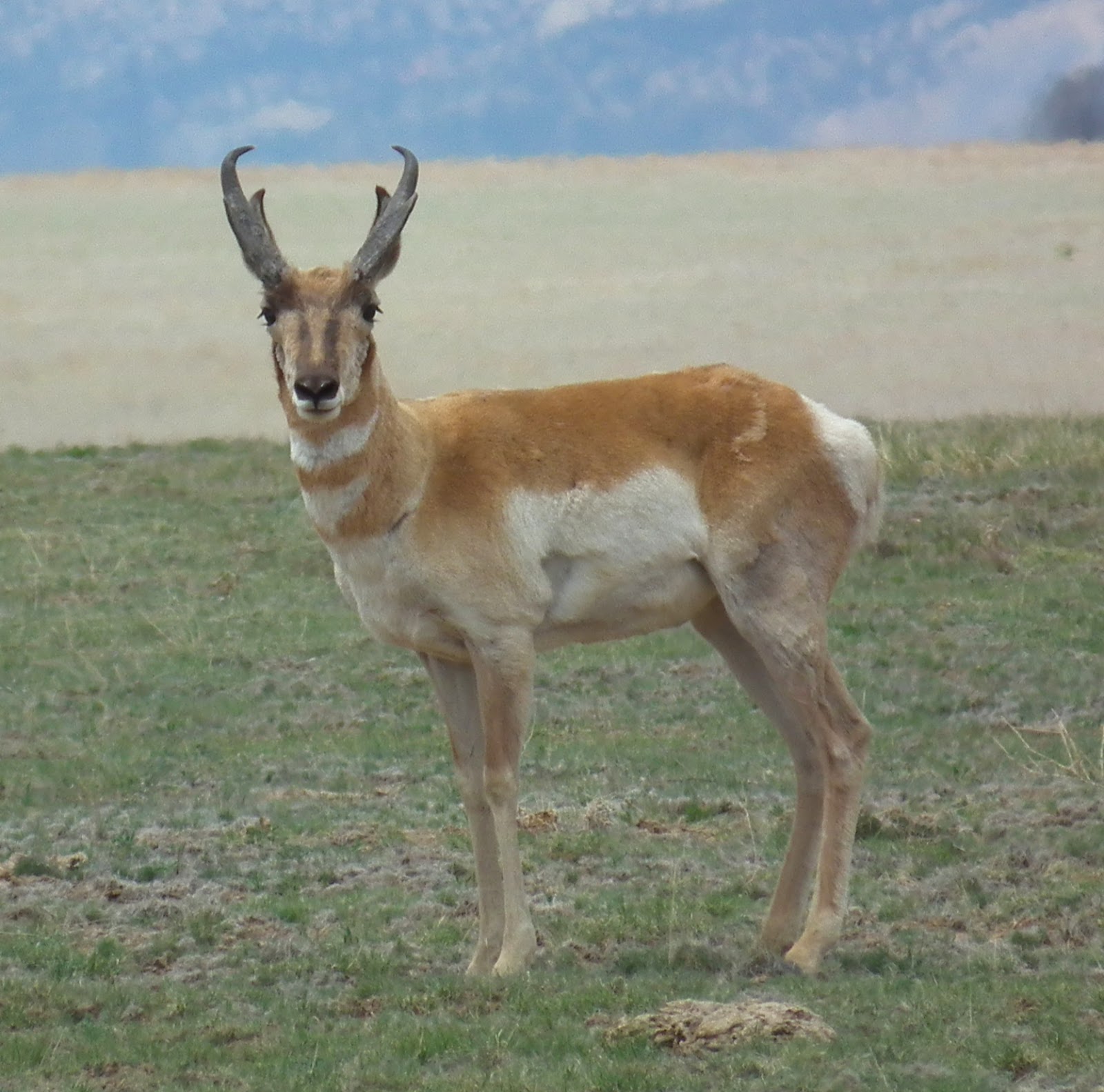
Pronghorn can frequently be seen roaming the plains of eastern New Mexico. 
Grine notes how great it is to see a young kid gush upon seeing the rings of Saturn through a telescope for the first time.

“It’s totally awesome to see,” he says.

It was the same for him when he first went out to the park on a field trip with his son and his junior high school class many years ago and saw Saturn through a telescope for the first time.

And now he’s the astronomy club’s president.

The park’s $75,000 Star Point Observatory opened in June 2006 and features a 12x16-foot building with a retractable roof that houses a 12-inch, computer operated telescope and remote television monitor which allows for group viewing.

The telescope and monitor is powered by a solar charged battery system.

The club also has several additional 8-inch telescopes that its volunteers set up on concrete pads outside the building which allows other guests to observe selected targets in the night sky too.
The Clayton Lake State Park observatory.
The observatory is NM State Park’s second to be constructed with the first having gone up several years earlier at City of the Rocks State Park in the southwestern corner of the state, according to Dave Gatterman, Bureau Chief of Design and Development for the state agency.

The agency would like to construct two more when finances become available, one in the northwest corner of the state at Heron Lake State Park and another at a yet to be determined location in the southeast quadrant of the state, Gatterman says.

Clayton Lake State Park and the local astronomy club will also entertain private groups. Anyone interested in making use of the observatory, camp sites or group shelters at the park can contact them by phone at 575-374-8808 or by email at charles.jordan@state.nm.us.

In addition to the observatory, the park is well known among anglers for producing record sized walleye as well as good sized bass, trout and bluefish.

The lake currently holds the state record for a walleye caught in 1989 by G.L. Peppers that weighed in at 16-lbs and 9-oz and measured over 32-inches in length.
Former NM Dept. of Game and Fish Conservation Officer, Kelly Dobbs, shows off a record breaking walleye discovered in Clayton lake State Park in 2010.
The park also enjoys a good reputation among bird and wildlife watchers and those interested in paleontology as a large set of dinosaur tracks were found and are now preserved in the earth that forms the dam’s spillway.

The park also features a new visitors’ center constructed of straw bale and recycled steel beams and while utilizing the latest in green energy techniques.

The visitor center also features an interpretive display inside which highlights the park and surrounding area’s history and other interesting information.
Clayton Lake State Park's state of the art, environmentally friendly, visitors center.
The park boasts over 30 campsites equipped with shelters, picnic table and fire rings.

There are seven sites with electric and water hookups and two large group shelters.

Showers are available inside the main restroom while numerous vault toilets are located throughout the park.

The park’s boat ramp is currently closed due to low water levels because of the ongoing drought but fishing from the bank is easy and good.

A ranger lives on site to help maintain the park’s family friendly atmosphere and camping this time of year is especially enjoyable with warm days, cool nights and only light breezes.
Clayton Lake State Park features great fishing and camping, fabulous scenery and spectacular night skies.
The park will also host its 12th annual Trout Derby the weekend of June 9 and 10th featuring a grand prize of a fully equipped fishing boat in addition to cash prizes for top catches.

Door prizes will be given away all weekend long too and there will be a hotdog eating contest, childrens’ sand dig and a horseshoe pitching contest.

The annual event attracts about 5,000 visitors and is fast becoming one of New Mexico’s best homegrown attractions.

For more information about the fishing derby contact the park or the Clayton Chamber of Commerce at 575-374-9253 or on their website at http://www.claytonnewmexico.org

If You Go: Take I-25 through Las Vegas and turnoff at Wagon Mound onto NM 120. Follow through Roy and continue on this remote and lonely stretch of two lane blacktop to the intersection of US 56. Head east on US 56 to Clayton. Take NM 370 north out of town to the turnoff to Clayton Lake State Park. About 250 miles one way.
NM 120 between Roy and the intersection of US 56.

Friday, April 06, 2012

Great Bass Fishing So Close to Santa Fe and Albuquerque it Should be Illegal


Leo Salcido, 30, of  Albuquerque, shows of a nice, fat, bigmouth bass he caught  at Shady Lakes recently.
For over 50 years Shady Lakes in Alameda has been providing anglers a lush retreat where the thrill of battling a big bass is only a cast away.

Within easy striking distance of Santa Fe or Albuquerque the lakes are located off State Road 313 in the picturesque Rio Grande Valley just south of Bernalillo.

The park offers largemouth bass, bluegill, channel catfish and trout fishing under the shade of great cottonwoods and in the shadow of the nearby Sandia Mountains.

Anglers will find the native population of bass a worthy challenge and feisty fighters when hooked.

And you won’t need a boat or have to drive a couple hundred miles to get into them.

Kids will find the “easy catch” pond a great place to learn the sport while pursuing pan sized trout.

Those seeking a bigger catch will find 16-inch trout or larger lurking in the next pond over.

Trout anglers must keep what they catch here paying 62-cents-per-inch for some tasty trout.

And although the bass ponds are generally catch and release, anglers who wish to keep a fish caught in them may do so for the same per-inch fee.
The ponds at Shady Lakes just south of Bernalillo are brimming with  largemouth bass lurking  in the shadows.
But in celebration of their 50-year anniversary the per-inch fee will be reduced to just 50 cents during the month of May for those customers who mention this article and wish staff a happy birthday.

The offer is restricted to one time use per customer.

Shady Lakes has been a family business and local institution since 1962 when Jim Phillips made a realtor an impromptu offer of $40,000 to buy what was an 11-acre, bait-fish farm, says youngest daughter Jan Phillips, who now manages the operation.

“I think he was having a mid-life crisis at the time,” she said of her father who was a newspaper advertising executive then. “We had a nice house in the Heights and my mother, Joanne, just about divorced him over it.”

But the Phillips’ stuck together, bought the farm and moved into a small, three bedroom, and adobe house on the property. They then all worked very hard for many years to transform the farm into the successful business it is today.

“And it worked mostly because of our cheap child labor,” says Phillips who along with her two sisters, Jean and Jill, and two brothers, John and Jay, worked many long days on the farm.

“But we had a ball growing up here too,” Phillips says of the rural, agricultural setting on the fringe of Albuquerque’s north valley.

The property is bordered by the Rio Grande and the towering cottonwoods of the surrounding Bosque while farm pastures dot the neighboring landscape.

Phillips, a graduate of West Mesa High School, fondly remembers climbing trees; building forts and playing hide and seek with her siblings on the sprawling grounds of the farm.

“I was a bit of a tom girl then,” says Phillips, a tall, single, athletic blonde with a big, bright smile and a laid-back demeanor.
Jan Phillips of Albuquerque operates her family's longstanding  business , Shady Lakes  just north of Albuquerque.
The family’s first job in taking over the farm back then was to drain the ponds and convert the facility from ditch water to well water.

“We had some awesome mud ball fights then,” Phillips recalls of cleaning out the ponds to rid them of carp and sucker fish.

The use of cold, clean groundwater then allowed them to plant game fish and water lilies and stock trout all summer long, Phillips says.

“We now get folks who’ll stop here just to catch a trout for dinner,” she says.

Phillips, 54, has been managing Shady Lakes since 1989 and hopes to continue doing so for many years to come.

“I just can’t imagine this not being open and available to the public,” she says.

But before taking over from her parents who have since passed on, Phillips spent many years working as a licensed practical nurse.

Like her brothers and sisters she too had left home to pursue her own career and life.

She quit work for a while to earn a degree in graphics design and illustration and even took an epic, summer long, cross-country road trip in a Volkswagen minibus.

“That may have been the best thing I’ve ever done,” she says of the trip which included a 10-day backcountry canoe voyage with an Outward Bound program in Minnesota.

“Now that was an experience,” she says with a touch of disbelief in her voice.

Then there was the time she found herself stranded in incredibly remote Glacier National Park of Montana with a burnt out wheel bearing on the bus.

And there was the engine fire while visiting Dinosaur National Monument outside of Vernal, Utah.

Luckily she was prepared with a fire extinguisher on hand.

“It got pretty hairy sometimes,” Phillips says. “But it was a great trip.”

Phillips says she regrettably sold the bus after blowing the engine but still finds herself seeking adventure, most recently having gone sky diving during a mountain biking vacation in Moab, Utah.

Daniel Hayden, 30, of Albuquerque says the key to success in fishing at Shady Lakes  is the taking a day off once in a while and just getting out there.

But it was while working once again as a nurse in Denver during the late 1980’s that Phillips kept having a recurring thought about the family farm.

Was there a market for the abundance of water lilies that they cultivated in the fishing ponds back home?

She made a few calls to local nurseries and discovered that supplies of aquatic plants were scarce while demand was great, and getting greater.

“They were asking me if I knew where they could get them,” she says.

Phillips had stumbled into the onset of what was fast becoming the residential garden pond craze.

So Phillips hustled back home to help her Mom who was managing the business since her Dad had returned to work with the state.

So Phillips set to work and ended up shipping water lilies all over the country and today she grows a variety of aquatic plants to supply the market.

Shady Lakes also stocks everything needed to construct and maintain a residential garden pond including liners, pumps, filters, ornamental fountains and even frogs, goldfish and koi fish.

And while the residential pond supply business has been instrumental in the operations’ success, it is the fishing that still gives her thrills.

“When those lilies bloom and you know those bass are hiding under there it can be pretty distracting,” she says.

Bass love that kind of cover and will hide under the lily pads where a well placed cast of an artificial frog might elicit a ferocious strike, she says.

The park store stocks basic fishing supplies but most serious bass anglers typically bring their own including the many different and unique varieties of soft plastic lures, spinners and top water flies developed for bass.
Carissa Malanowski,34, of Albuquerque who works at Shady Lakes where one of the perks is the fishing shows off her private stash of bass lures.
Shady Lakes makes for a great fishing destination due to its abundance of fish, its nearby location and spectacular ambiance and scenery.

And a state fishing license is not required on the private waters at Shady Lakes.

Private fishing permits at Shady Lakes are $7.50 for trout ($5.50 for kids and seniors) and $10.50 for bass, bluegill or catfish.

For more information go to www.shadylakes.com. or give them a call at (505) 898-2568.

Karl F. Moffatt is a longtime New Mexico journalist and avid outdoorsman who can be contacted through his blog at www.outdoorsnewmexico.com

If You Go: From Santa Fe one can take the Rail Runner train and get off at the Sandia station or elect to drive on I-25 south to the Tramway exit, head west toward the river and at the traffic circle turn north on NM 313 and follow to nearby Shady Lakes.


Friday, February 10, 2012

Hunting & Fishing Show to Feature Local Bamboo Rod Builder

When the doors open and the crowds start to filter in at Bob Gerding’s annual hunting and fishing show this weekend, fledgling bamboo fly rod builder Bruce Smith of Edgewood will be there to realize his dream.

“It’s pretty exciting,” the retired master carpenter said during a recent interview at his modest work shop tucked away in the hills of southern Santa Fe County. “And I’d be lying if I didn’t admit I’ve had some butterflies in my stomach.”

Smith will be exhibiting over a dozen of his meticulously hand crafted bamboo rods at the show and providing information on the history, construction and use of split bamboo cane rods.
Bamboo rods are considered by many fly fishing purists to be the best an angler can use. They are said to provide smoother casting, a supple feel and better response when a fish is on the line.

Gerding’s 14th annual hunting and fishing show kicks off at noon on Friday and runs through the weekend inside the Manuel Lujan Center on the state fairgrounds at Expo New Mexico.

Exhibitors will include hunting and fishing outfitters, outdoor product vendors, educational seminars and other activities.

And this year the angling group New Mexico Trout will be holding its annual fly tying symposium featuring top fly tiers during the show.

The popular King Salmon fishing simulator will also be back this year too, says promoter Bob Gerding who is in 14th year of running the show.
Tickets are $8 and kids under 12-years-old get in free. For more info go to http://bobsoutadv.com/

Smith, in pursuing a career as a bamboo rod building career, is carrying on a family tradition of sorts.

Smith says his grandfather, Clyde Lester of Spokane, Washington, was a fisherman who liked to fix up old rods and reels in his shop when he wasn’t working construction.

“He was a gas to hang around,” Smith, 62, says of Lester whom his family often visited for vacation.

Lester worked with bamboo which was prevalent then as fiberglass and graphite rods had yet to hit the market.

“I was fascinated by his work and always dreamed of doing the same thing,” Smith says of those days hanging around with his grandfather who also taught him the art of fly fishing.

So when the economy tanked a few years back Smith finally got his chance to pursue his dream.

After 27 years of exclusively building stairs for construction companies like Pulte, Sivage and Stillbrooke Homes and also Accent Stairs in Albuquerque, Smith called it quits and got to work on his own small business.
His shop now features the tools of his new trade including specialized equipment he constructed himself for splitting and shaping the bamboo cane, wrapping, varnishing and drying the rods and other construction techniques.

Smith’s rods can be custom built to include gold plating, exotic wood rod handles, special paint schemes, carrying cases or whatever a customer may want to personalize their rod, Smith says.

Smith’s business venture is called Sweetrock Rodsmiths and in addition to crafting over a dozen rods for display at the show he has even built his own website which can been seen at http://www.sweetrockrodsmiths.com/.

And as far as Smith knows there’s only one other bamboo rod builder in the state that’s in the business.
Smith grew up in Albuquerque where his father, Clifford Smith, was a high ranking naval officer with the Naval Weapons Evaluation Command at Kirtland Air Force base.

Smith graduated from Del Norte High School in 1968 and set out to pursue his own career in the Navy serving as a machinery repairman with the Seabees.

But while on leave in Albuquerque in 1972 and preparing to travel to a new duty station in San Diego he was involved in an accident that drastically changed his life.

Smith got his vehicle stuck in a ditch on a country road while visiting friends and upon winching it out was severely injured when the cable snapped and nearly took off his leg.

His naval career came screeching to halt and his medical recovery took years to accomplish.

“There were no disability or insurance payments,” Smith said. “So I just had to suck it up and move on. The toughest part was learning not to be bitter.”

The accident left him with some serious emotional and physical problems to overcome and he came close to living off the streets at one point, Smith says.

But with the help of his family and friends Smith overcame those hurdles and went on to find a new career specializing in the construction of staircases, a specialty within the housing industry.

Smith is a long divorced bachelor who is still very good friends his wife, Karen, and they have a daughter, Kelsa, who is a graduate student at the University of New Mexico.

Smith’s father has since passed on but his mother, Jean, at 91-years-old is still well enough to have travelled on her own to visit family on the west coast over the holidays, he says.

Smith said that in making his debut at the hunting and fishing show Smith sees it as overcoming yet another difficult situation in life and moving on to a better place, something he hopes fellow vets returning from the Iraq war can accomplish too.


Popular Posts