Wednesday, March 20, 2013

Some tips for spring fishing on New Mexico's waters.

The late Sarge Wethington, father of longtime New Mexico Department of Game and Fish Fisheries Biologist on the San Juan river at Navajo Dam, Marc Wethington, shows how it was done on the San Juan back in the day. Photo courtesy of the Wethington family. 

It's spring in New Mexico and the uptick in temps should bring out the fish so now's a good time to unpack your angling gear and get out there.

Here are a few tips for fishing this time of year.

Do your homework by checking the fishing report first. The N.M. Department of Game and Fish's statewide fishing report can be found here http://www.wildlife.state.nm.us/fishing/weekly-report/.

Check the weather too. Excellent forecasts and current weather conditions from the federal government can be found at the https://www.weather.gov/abq/.

Stream flow information also can be helpful. Look on the US Geological Service website at http://nm.water.usgs.gov/ for that kind of data. Look at historical stream levels to try and gauge when snowpack runoff is high which will affect water and angling conditions.

For fishing on New Mexico’s rivers and streams anything flowing below 150 cubic-feet-per-second (CFS) is probably going to be fine to fish. 

Watch the peak high and low water flows to determine the best time of day to fish your favorite water.  This time of year it’s usually from 10 a.m. to about 3 p.m. on a stream like the Jemez which typically is “on” long before any others in northern New Mexico. 

Consider fishing waters in southern New Mexico this time of year too as they’ve already warmed up down there. 

And don’t be put off if you arrive at a favorite stream or river to find to find it off-color. Put that to work to your advantage instead as it’s much easier to get close to your work without spooking fish.

Fish areas methodically under murky water conditions and use high visibility patterns like a prince nymph with a gold bead head or a black woolly bugger laced with crystal flash. 

Spinners are notoriously effective this time year too and single, barbless, blades can be had from http://www.fisher-chick.com/.

A Fisher-Chick barbless, single hook, spinning lure at work on a Rainbow trout.  
Work the edge of currents, up close to the banks and in spots where trout may be resting and the current brings food to them. 

Trout won’t waste a lot of time chasing food this time of year so it’s important to put your fly, lure or bait right in front of them.

And remember to fish open areas of water that have been exposed to the sun as fish may be more active in these warmer waters.

Those fishing with bait such as worms and salmon eggs have an added advantage when fishing murky water as trout and other fish rely more on their powerful sense of smell to detect food under those conditions.

Those who prefer to fish our many ponds, lakes and reservoirs will find that the last few years of drought have brought the water down at many popular fisheries. Lake and reservoir levels can be checked here https://www.wcc.nrcs.usda.gov/basin.html.

This has in some cases proven to be a boon for bank fisher men and women as the fish are more concentrated and easier to get at. Conchas Lake has been fishing good despite the drought for the past several years and a visit is highly recommended. 
 
Fishing waters at many tribal and private operations are also good places to try during the spring time as stocking is well under way.

The lake at San Ildefonso Pueblo is usually well stocked and an enjoyable place to visit this time of year. 

The key to successful early spring fishing is to do some homework, take a day off and get out there!

Monday, December 31, 2012

Sleigh Rides at Valles Caldera Make for Great Winter Fun

The musky scent of horses and the creak of a wood sleigh as it slips across a sea of brilliant snow at the Valles Caldera National Preserve can make for an enchanting winter excursion.

“There is just something so magical about the sound of the bells as the horse-drawn sleigh transports you across our winter landscape,” says Kim DeVall, Recreation and Education Specialist at the 90,000-acre public preserve in the Jemez Mountains. “It’s a unique experience most people will never forget.”

The preserve, off NM 4 between Los Alamos and Jemez Springs, sits in the bowl of an ancient collapsed volcano that once held a massive lake.

But today, vast meadows and stands of towering ponderosa pines dominate the landscape.

Great herds of elk make the preserve their home and trout streams sluice their way through its expansive pastures.

But in winter, when the snow arrives, the landscape is blanketed in a sea of blinding white snow and outdoor recreationists flock to its fields.

While offering snowshoeing, cross-country skiing and other activities during the winter months, it’s the sleigh rides that many visitors seem to find so appealing.

Reservations to ride the sleighs between Dec. 21 and Feb. 18 can fill quickly due to the rides popularity.
During the holidays potential visitors will find several rides a day available over a string of consecutive days. After that the schedule reverts to weekends only.

See the preserve’s website at www.vallescaldera.gov for reservations and more information about available dates.

Costs are $30 for adults, $24 for those 62 and older. Kids under 15 years old pay $15 while children under four ride free.

It should be noted that in the event that the winter produces little or no snow a wagon will be substituted for a sleigh.

Riders will want to dress warmly in layers and bring sunscreen and sunglasses to deal with the brightness of the winter landscape.

Gathered together in a gently swaying, open sleigh about a dozen riders per trip will enjoy an estimated one hour ride during which an guide will offer information about the preserve’s history, wildlife and other details.

In 2000 the federal government bought the spectacular ranch from the Dunigan family of Texas for a little over a $100 million.

As part of the deal the ranch continues to operate under a unique management plan which includes public use through a variety of recreational programs.

Riding along in a sleigh amid the crisp, clean mountain air with sleigh bells tinkling and horses huffing is just one of the many public recreational programs offered at the preserve during the holidays.

The preserve also offers during the year, hiking, elk and turkey hunting, fishing and horseback riding and many special events including mountain biking and photography clinics.

For more information, visit the preserve’s website or call their recreation and reservation hotline at (866) 382-5537.

If You Go: From Santa Fe head north on US84/285 to Pojoaque and turn off onto NM 502, the road to Los Alamos. Follow to the White Rock turnoff and then stay on NM 4 through the mountains to the preserve. About 65 miles one-way.

Thursday, October 18, 2012

Salmon Snagging Season is On!

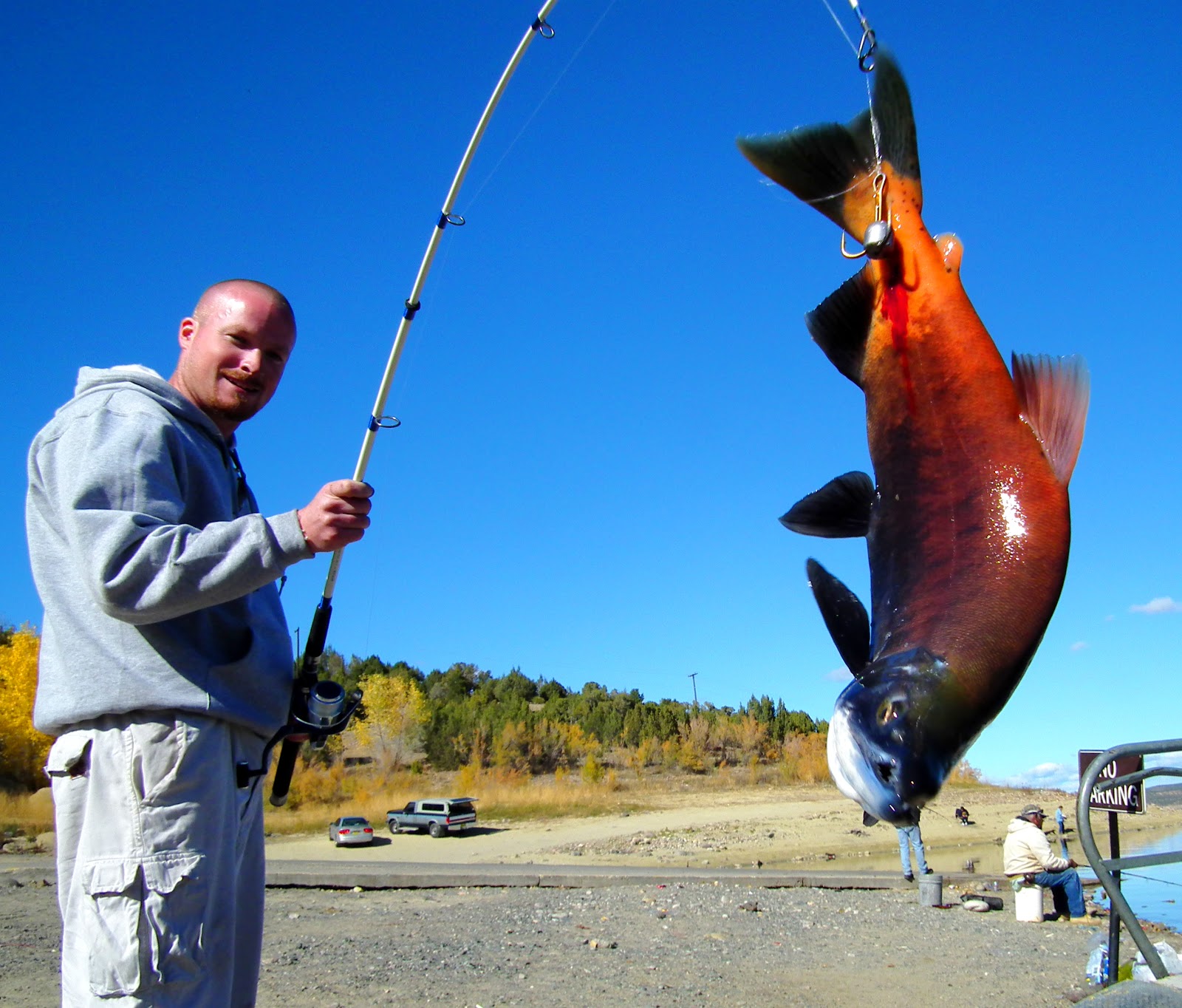
Steve Chase, 28, of Laguna, NM shows off a fat salmon he snagged at Navajo Lake last year.
Salmon snagging season has begun across much of northern New Mexico, drawing a hardy group of anglers to area lakes where the brightly colored, tasty fish can be caught in big numbers.

“It’s a long-standing tradition and great way to stock the freezer,” says Marc Wethington, Fisheries Biologist for the state Department of Game and Fish (NMDGF). “But it’s not for the faint of heart.”

New Mexico’s kokanee salmon are stocked, landlocked, sockeye salmon that upon reaching sexual maturity, usually at the age of about four, will mass in schools during the fall in a futile effort to spawn.

Because salmon typically need a river and proper conditions under which to reproduce, these fish will not find much success at that in New Mexico’s lakes.

And then they’ll begin to die.

Which is why the state has a special snagging season beginning Oct. 1 at Navajo, El Vado, Abiquiu and Eagle Nest lakes where anglers are allowed to use heavily weighted treble hooks to snare and keep up to 12 salmon a day.

The angling method requires little finesse, just a heavy line on an expendable rod and then finding where the fish have amassed. Usually a crowd of other anglers is a good indication.

Then the angler heaves his hook into the water and repeatedly rips and reels in an attempt to snag a fish.

It’s a popular method for harvesting a great deal of the fish that are said to be good eating especially if caught early in the snagging season.

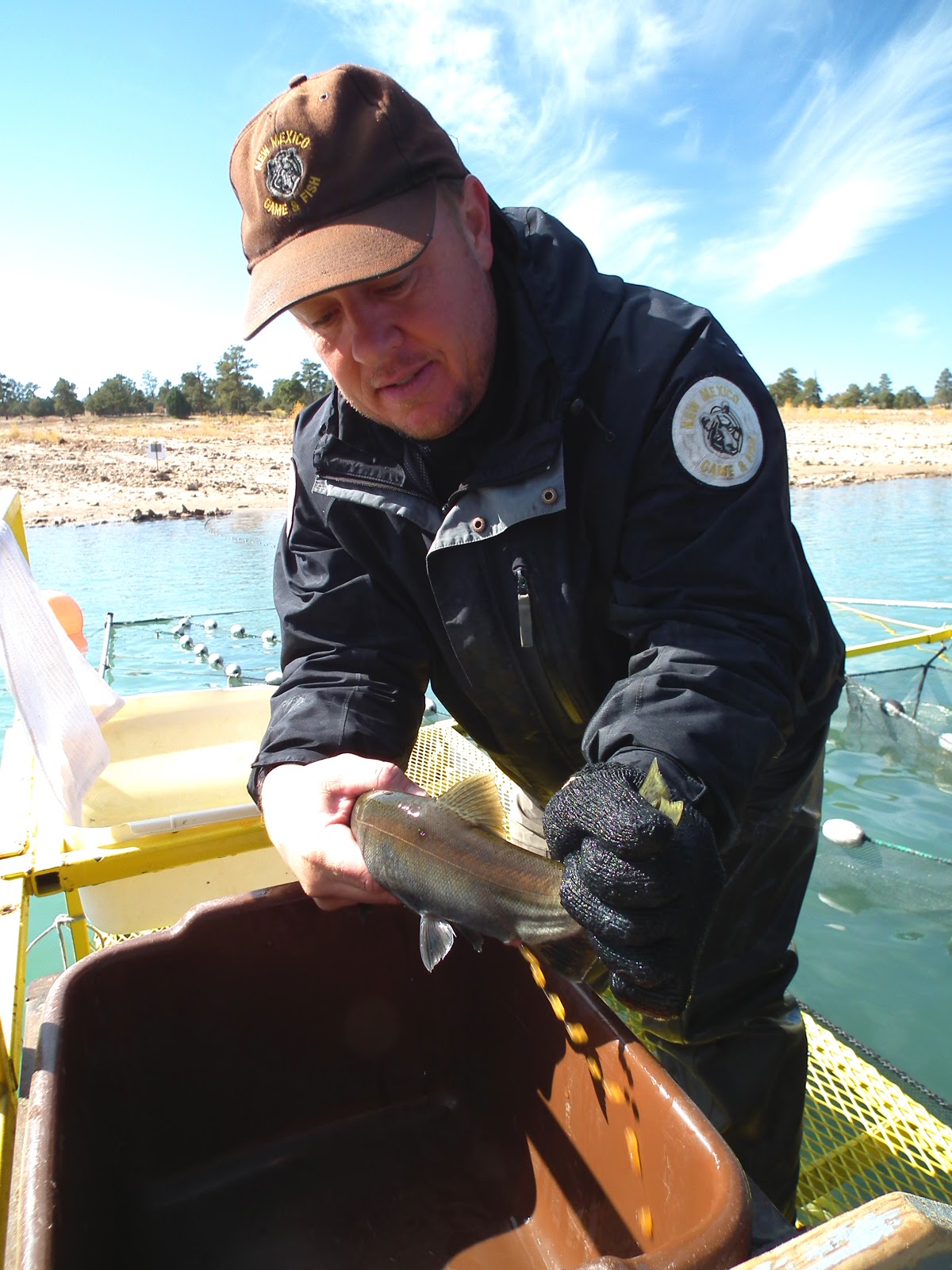
Heron Lake won’t be open to snagging until mid-November  to accommodate NMDGF workers who will spend the next few weeks capturing and milking millions of eggs from spawning salmon there.
Shaun Green of the NMDGF milks a salmon during the annual operation at Heron Lake in Nov. 2011.
The eggs will then be collected, sorted, fertilized and reared at the department’s nearby Los Ojos hatchery and used to restock the state's deep water lakes with the popular sport fish.

Heron Lake is where Joe Carrillo, 35, of Tierra Amarilla, plans to be with his son and a good buddy for their annual “midnight run” on opening day.

“It’s become a tradition of ours,” Carrillo says.” It’s usually the last outing of the year before the snow flies.”

Carrillo says he’ll go out to the lake that Friday evening and grab a nap at a campsite before hitting the water at the stroke of midnight.

“I’ve been skunked before waiting till morning,” he says.

Carrillo says it’s “combat fishing” with lots of anglers bundled up in bulky, winter wear and standing shoulder to shoulder, slinging their heavy treble hooks around.

“You’ve got to watch your back and keep an eye on your neighbor but there’s some etiquette practiced there, too,” he says. “It’s a good time.”

Many anglers like to head over to Eagle Nest where the snagging might start a little earlier due to the lower temps found in the high country, says Sue Finley of Eagle Nest Marina.
Eagle Nest Lake in northern New Mexico.
The marina is found off Highway 64 on the south side of the lake and anglers can inquire there about fishing conditions and grab some supplies before heading down to the water.

Many anglers like to congregate on the south side of the lake at the boat ramp and along the shoreline near the new campground and visitor center at Eagle Nest Lake State park, says Marshall Garcia, superintendent and 30-year veteran of the state agency.

Anglers can camp out at the state park until Dec. 1 at any one of the park’s 19 sites featuring a shelter, picnic table and campfire ring. There are no utilities available other than a communal water spigot and outhouse, he notes.
The campground overlooking Eagle Nest Lake State Park.
Anglers at Eagle Nest Lake will find plenty of other fishing to keep them entertained after snagging their limit for the day, says Mark Stewart of Dos Amigos Anglers in downtown Eagle’s Nest.

Trout will stalk the spawning salmon schools and feed off eggs that come free, he says.

Stewart notes that one of the traditional uses of salmon during the spawning season is the collection of their eggs for use in “roe sacks” which can then be used to fish for any big trout stalking the spawners.

Anglers will cut a small square of old pantyhose and wrap it into a bundle with some eggs and a small marshmallow inside to help it float and then tie the bundle with thread around a treble hook and set out after trout.

The same method can be used to snare a pike, too, he says.

The notoriously predatory pike were illegally stocked into the lake by someone and their population has grown at an alarming rate with some pike being found in the 30-inch range.

The NMDGF has lifted the bag limit on pike at Eagle Nest and require anglers to keep any and all pike they catch from the lake. The department wants to eliminate as many of the predatory fish as possible to limit the damage they are inflicting on the popular trout and salmon fishery.
Steve Hesch, 51, of Los Alamos shows of a pike he caught during a Feb. 2012 ice fishing derby at Eagle Nest Lake.
Stewart says bagging a pike would not only be a great catch but be a good way to help the lake too.

Anglers will find the north side of the lake at the Moreno Day Use area and further down the bank at the Honey Hole between the old hotel and the dam to be good spots to snag for salmon and fish for trout and pike too.


If You Go: From Santa Fe take US 84/285 north through Espanola to reach Abiquiu Lake and for El Vado and Heron Lakes, just continue on the highway up to Tierra Amarilla and follow the signs. For Navajo Lake continue on US 84 through Chama to US 64 at the turn off to Dulce. Follow to NM 527 and cross the dam to reach the marina. For Eagle Nest Lake take NM 68 out of Espanola and then turn east on US 64 at Taos and follow to the lake.


Sunday, September 23, 2012

Record Breaking, Trophy Sized Tiger Muskies at Bluewater Lake

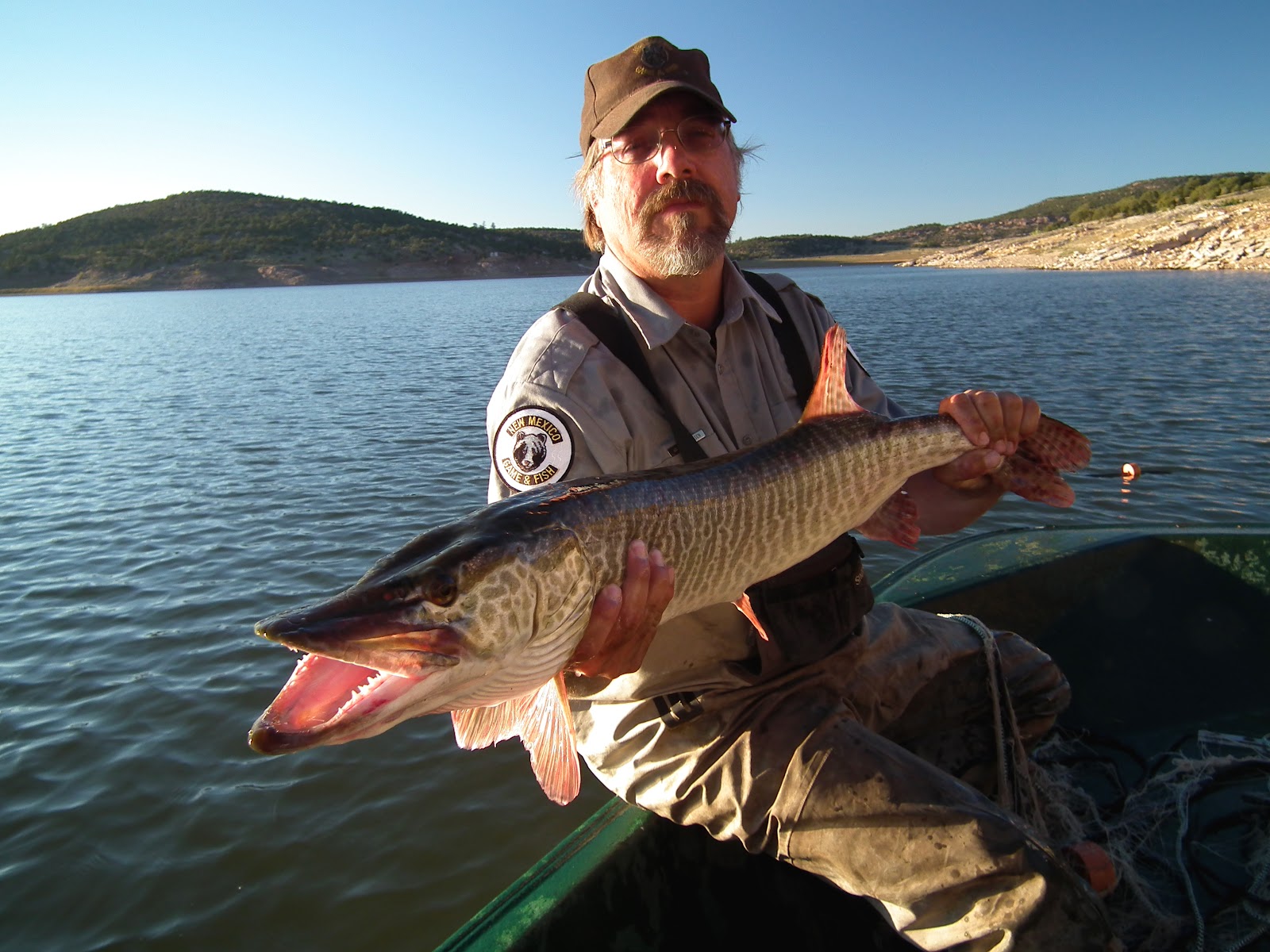
New Mexico Department of Game and Fish (NMDGF) Conservation Officer, Travis Nygren, shows off one of the giant tiger muskies found at Bluewater Lake in western New Mexico.
The Tiger muskie fishing at Bluewater Lake is so good these days its drawing anglers from across the state looking to land a trophy sized fish and maybe even break the state record.

“It’s crazy out here,” says Rodney Busch, 28, of Bluewater Village who frequently fishes the lake near his home. “There’s people coming from all over, even out of state, just to catch them.”

The state record has changed hands four times in just over a year and is currently held by Marcos Mata of Albuquerque after he snared a monstrous 50.5-inch, 38-pound, 2-ounce muskie at Bluewater Lake in July using a two-inch, silver, artificial minnow.
Bluewater Lake as seen from an overlook in the state park high above the water.  
Prior to Mata’s catch the record was held by a guy from Edgewood who had taken it from a Truth or Consequences fisherman who had snagged it from an Albuquerque angler, according to state Department of Game and Fish records.

All took their record catch from Bluewater Lake in western New Mexico.

The International Game Fish Association’s North American record is for a 51-pound, 3-ounce tiger muskie caught at Lac Vieux-Desert, Mich. caught in 1919.

At the rate record catches are being recorded at Bluewater Lake someone could possibly take the national record too.

Tiger Muskie records are measured by weight not length.

Tiger muskies were planted in Bluewater and Quemado lakes back in 2003 by the state Department of Game and Fish (NMDGF) to get handle on a population explosion of unwanted white sucker and gold fish.

These undesirable “trash” fish compete for limited resources with “sport” fish such as trout and in both lakes they had grown out of control.
NMDGF Conservation Officer,Travis Nygren, holds up one of the many white sucker fish found in Bluewater lake that has prompted fishery managers to stock predatory tiger muskies in an effort to control their numbers. 
Tiger muskies which are a sterile hybrid cross between a muskie and a pike can be raised in hatcheries and then stocked in lakes for use in controlling undesirable fish populations.

Tiger muskies are long, sleek predators armed with vicious teeth that tend to grow fast and big. They’ve been stocked in both lakes every other year since 2003, according to NMDGF coldwater fisheries biologist, Richard Hansen.

The tiger muskies have done such a good job in reducing the undesirable fish populations at both lakes that anglers can now catch and keep a single trophy tiger muskie over 40-inches long from either lake.

And now anglers who once sought trout at these two lakes are learning to fish for these monsters until the trout come back.

During a recent September survey of Bluewater Lake by Hansen he found the tiger muskie population to be thriving but white sucker and goldfish still present.
Richard Hansen, NMDGF Coldwater Fisheries Biologist, shows off one of the younger  tiger muskies caught at Bluewater Lake during a recent population survey.
The biggest Tiger muskie netted during the survey was a 26-pounder measuring about 43-inches long and many more tiger muskies in the 20 and 30-inch range were also found.

Hansen said that not enough trout were located during the survey to make a determination about their status.

He noted that perhaps due to drought related low water levels and higher water temperatures that perhaps they were hiding out in the deeper water.

The NMDGF crew spent much of its time working just offshore in shallower water using gill nets and electro-shocking equipment.

But a similar survey this spring revealed a good sampling of trout, Hansen said and he will continue to evaluate the situation to determine how to proceed with any future trout stocking plans.

Hansen noted that trout appear to be coexisting well with tiger muskies in Quemado Lake and that methods used there to maintain the stocked trout population might work at Bluewater too.

In the meantime the lake continues to draw anglers from all over for a chance to catch one of the prehistoric looking fish.
People aren't the only ones fishing at Bluewater Lake as evidenced by the Osprey waiting in a tree on the shoreline for a chance to catch a meal.
Anglers wishing to fish for tiger muskies should be aware of some special equipment needed to do so successfully, according to Matt Pelletier, president of the 65-member New Mexico Muskies Inc., a local chapter of the national organization formed in 2008.

Anglers will need at least a seven foot long, heavyweight rod capable of handling at least a 20-weight line and a one-ounce lure with an open face spinning or bait casting reel.

Wire leaders are recommended and typical lures would include jerk baits that resemble goldfish, suckers and trout, Pelletier says.

Anglers should be equipped with a pair of long, needle nose pliers for dislodging hooks. They should also take along a pair of heavy nippers for cutting hooks off if needed and a pair of jaw spreaders to open the fish’s mouth and get at any embedded hooks.

Anglers should have a very large net or preferably, a sling net, in which the fish can be cradled in the water which is necessary for handling the fish properly without harming it or the angler.

“We practice and preach catch and release to conserve the resource,” Pelletier says.

Those fishing for tiger muskies need to practice patience and persistence as the fish feed on a limited schedule and anglers need to have their lures in the water when they’re ready to feed, Pelletier says.
Frequent Bluewater Lake angler, Rodney Busch, says a simple white diving lure like this beat up bomber has worked well for him at attracting strikes from tiger muskies.
Tiger muskies have a slow metabolism and after a good sized meal may not eat again for some time which accounts for their sporadic feeding behavior, he says.

The key to attracting a strike from a tiger muskie is to capitalize on its opportunistic, predatory instinct with jerks and motion of the lure that imitate a wounded or struggling prey, Pelletier said.

For more information about fishing for tiger muskies check out the club’s website at http://www.newmexicomuskiesinc.org.

For anglers looking to make the record book check out NMDGF’s website at www.wildlife.state.nm.us for rules, regulations and record applications.

On the way out to Bluewater Lake in west central New Mexico take time to check out the many attractions to be found along old Route 66 such as the many classic cars available at Oscars Auto Sales near Grants. 
If You Go: Take I-25 south to I-40 and then head west to just past Grants. Take NM 412 at the Prewitt exit and follow to the lake.

This story also appeared in the Santa Fe New Mexican and can be seen at http://www.santafenewmexican.com/Local%20News/092312bluewater

Tuesday, September 04, 2012

Don Wolfley: Last of the Old School Fishing Guides at Heron Lake

It’s a hazy summer morning at Heron Lake and fishing guide Don Wolfley is backing his 24-foot pontoon boat into the water for a day of deep sea fishing - New Mexico style!

“Remember you’ve got to stay in contact with them,” he says of the deep running salmon we hope to hook into this day. “If you can’t feel, then reel. Don’t stop reeling.”

Wolfley, 67, is heading into his 17th year of guiding on Heron Lake in northern New Mexico and is one of the last of the “old school” breed of fishing guides.
“I’m the last one here,” he says of the deep, cold, lake with its plankton rich green waters where anglers have flocked for years to chase tasty salmon and catch giant lake trout. “There once used to be seven of us.”

Wolfley guides for Stone House Lodge located on the lake and his own clients through Heron Lake Guide Service.

Wolfley, a self described laid back and unassuming guy, says he still gets a big kick out of fishing after all these years and will continue guiding as long as he still does.

“I just take it a season at a time,” he says.

Wolfley says fishing for the landlocked salmon stocked in Heron Lake by the New Mexico Department of Game and Fish is a little different than some anglers might expect.
A typical Heron Lake salmon.
The silvery fish found at Heron Lake typically range in size from 12 to 20 inches with the average catch being about 15 inches.

They have a soft mouth and can be easily lost if an angler fights them too hard.

“They can be a tough fish to catch,” he says. “They require finesse and a light touch.”

Salmon tend to run in schools and can best be found by using a boat outfitted with a sonar fish finder which also determines the quarry’s depth.

Once the fish are located, Wolfley then uses a set of downriggers to take his fishing line and lures down to the best depth to catch them.

Wolfley’s downriggers incorporate a heavy weight attached to a metal line wound upon an electrically operated winch with a depth counter.

A trolling rod and reel is mounted into a nearby holder and its line is lightly attached by a pressure sensitive clip to the downrigger.
A downrigger and fishing line ready to be to be deployed.
The downrigger in then lowered into the water where it drags the fishing line and lure down to the desired depth.

Attached to the fishing line just above a lure baited with Wolfley’s specially scented corn is a flashy metal spoon designed to catch the salmon’s attention as the rig runs through the water.
Then as the boat idles along slowly, it’s time to watch for a strike indicated by a good twitch and deep bend in the rod as a fish is hooked.

Then comes the tough part: Reeling in quickly while lifting the rod tip to unsnap the downrigger clip from the fishing line.

After that the rod should be dropped back down towards the water’s surface and the line reeled in to establish contact with the fish.

If a salmon is on the line, it will soon be felt tugging, then the angler can gently reel it in, stopping if the fish starts to run and resuming when it doesn’t.

Lastly as the salmon comes into view the angler needs to gently coax it to the surface.

Then with a lift of the rod the fish should break the surface, where Wolfley can get his net under it.

“But sometimes you can lose one there at the end,” Wolfley says. “And that’s just fishing.”

But if successful, the angler will get a high five from Wolfley and can keep going until filling his or her limit of five fish for the day.

Wolfley cleans and filets all of his client’s fish and packages them to be taken home to cook.

And just like the salmon found at the supermarket, the fish from Heron Lake possess a bright orange color and when properly dressed contain few if any bones to deal with.

Salmon filets can be breaded and fried, broiled or grilled.  It’s all good.
And fish fresh from the water and caught with your own hand seem to be even more flavorful, Wolfley notes.

Wolfley, a trim and fit man who once used to run long distance marathons because it gave him time to think, is a retired Albuquerque Public Schools administrator with a master’s degree from the University of New Mexico (UNM).

Wolfley’s wife, Norma, is also retired from the Albuquerque Public Schools where she taught for more than 30 years.

The couple has a daughter, Linda, who is pursuing a medical degree at UNM.

Wolfley says the two love to fish and that his wife is better at it than he.

“Oh, she’s good, alright,” he says as he describes the big, 17-pound lake trout she once caught in Heron Lake or the giant 21-inch salmon she once reeled in from the lake’s depths.
During the summer the couple share a modest home nestled on a ridge overlooking El Vado Lake just downstream of Heron Lake on the Chama River.

“It’s the best of both worlds, having the two lakes,” Wolfley says. “And it’s quiet and peaceful.”

Anglers can fish for big lake trout with Wolfley during the early months of the year in March, April and May and then sign on for salmon fishing during the summer and fall.

Wolfley usually calls it quits for the season around the beginning of October and then spends his winter at his second home in Albuquerque.

And while a day on the lake with Wolfley can be exciting when the fish are on, it can be relaxing, too, especially when good conversation fills the void between strikes.
Wolfley hails originally from the backwoods of Pennsylvania where he grew up fishing with his brother, Howard, on the lakes, rivers and streams around their boyhood home of Enola.

His father, Fulton, was a railroad worker and his mother, Mary, a homemaker.

“It’s kind of funny because my dad had these old bamboo flyfishing rods that we used to use like you would a cane pole,” Wolfley says. “Just to dangle a worm in the water.”

Today vintage bamboo fly rods are considered highly valued antiques by many fly fishing purists.

And while Wolfley has fly fished too, he still thinks that pound for pound the earth worm is the most effective tool for catching fish.

“I guess I’m just old school that way,” he says.
An Osprey flies away after snatching a fish from the water at Heron Lake.
It was in the early 1960s that Wolfley moved out West like his brother did before him and was accepted at UNM.

“It was a bit of geographic culture shock,” Wolfley says of the move. “At first I couldn’t get over the scarcity of grass and trees and there was all this blowing dust. But I always did like Mexican food, so it kind of grew on me.”

And nowadays you can’t get Wolfley to stop singing the praises of his adopted home state, especially the scenic mountain vistas and sparkling waters found at Heron and El Vado Lakes.

If You Go: From Santa Fe take US84/285 north to Espanola. Cross the river and stay on US84 through Abiquiu and on north towards Chama. After passing the village of Los Ojos take the turnoff to Heron Lake on NM 95.


Popular Posts