Friday, January 12, 2018

Enchanted Forest cross-country skiing and snowshoe area closed due to lack of snow


The Enchanted Forest cross-country ski and snowshoe area in northern New Mexico remains closed due to a lack of snow and the operator is seeking financial donations to help stay afloat until next year.

“This is unprecedented, there’s just no snow and we weren’t prepared for this,” says Ellen Miller-Goins of Red River, owner of the outdoor resort.

The 600-acre cross country ski and snowshoeing area is in the Carson National Forest near Bobcat Pass between Red River and Eagle Nest.

Snow pack across New Mexico and southern Colorado is way down this year due to drought this fall and early winter.

While many ski areas can make snow to stay open for business, Miller-Goins can’t and remains closed.

To offset the loss of business income and help cover expenses Miller-Goins is appealing to the public for help.

Those interested in donating can go online to her fundraising campaign page on Indiegogo’s website at https://www.indiegogo.com/projects/save-enchanted-forest#/.

The campaign has raised almost $8,000 from more than 80 people so far while the goal is to reach $27,500.

Country music star, Michael Martin Murphy, who spends many of his summers in Red River helped out with a benefit concert last weekend at the Motherlode Saloon that raised almost $10,000.

“We had a good turnout and great time,” Miller-Goins. “It was very intimate and wonderful concert.” 


Miller-Goins says if enough snows falls in the coming months she may be able to open but she isn’t counting on that happening.

Kerry Jones, meteorologist with the National Weather Service, in Albuquerque says the outlook for snow in the coming months is well below average.

“I don’t think anyone had any idea it was going to be this brutal,” Jones says of the lack of statewide precipitation this fall and early winter. “This time last year they had four to five feet of snow at Bobcat Pass, there’s isn’t really anything on the ground up there right now.” The agency regularly measures snowpack at a site near Bobcat Pass.

The area’s so dry that Colfax County Fire Marshal Larry Osborn has just imposed a fire ban in some areas of the county.
The Enchanted Forest cross country ski area was created by Miller-Goins’ parents in the mid-1980s and she has been running it since 2010.

When there’s snow on the ground the recreation area features many miles of groomed trails, equipment rentals, lessons and heated yurts where cross-country skiers and snowshoers can spend nights in the backcountry.


“I love this place and other people do too,” says Miller-Goins. “And New Mexico needs places like this for our tourism economy to thrive so I hope people can help out.”

Miller-Goins also operates the Sangre de Cristo Chronicle, an online newspaper at www.sangrechronicle.comthat covers the Angel Fire, Eagle Nest, Red River, Cimarron and Taos area.


Monday, December 18, 2017

San Juan River's Simon Canyon Run Under Restoration

Last Chance run on the San Juan River below Simon Canyon.
New Mexico’s trophy trout fishery, the San Juan River below Navajo Dam, will be getting an upgrade for Christmas including two new boat ramps and many in-stream habitat improvements.

“This is a win-win project designed to benefit anglers, guides, outdoor enthusiasts and wildlife,” says Marc Wethington, New Mexico Department of Game and Fish biologist stationed on the river.

Work is scheduled to commence this month on about a mile of river between Simon Canyon and the Gravel Pit boat takeout. The area will be closed to the public during construction and boaters can use a temporary boat ramp on the river’s back channel at Munoz to takeout. Construction could take up to three months.

The estimated $1 million project caps efforts to improve this stretch of the river that was devastated by massive flooding in late 2014.

The flood from Simon Canyon smothered the riverbed with tons of sand and silt which killed off much of the bug life that sustains fish. What had been one of the river’s best dry-fly fishing areas held far fewer trout and fishing declined.

Simon Canyon.
Control of erosion and storm runoff was needed on the surrounding mesas that feed Simon Canyon and Sen. Martin Heinrich D-N.M., helped get it done.

“I am proud I was able to work with the San Juan Guide Association, the Bureau of Land Management (BLM) in Farmington, Conoco Phillips and other stakeholders to improve the Simon Canyon watershed and reduce sediment flow into the San Juan River,” Heinrich said in a written statement. “The community needed immediate action and we were able to effectively deliver tangible and pragmatic results to ensure the San Juan River will continue to be a thriving and top destination for fly fishing in the country.”

The BLM conducted juniper and pinon tree thinning projects and planted native grasses on hundreds of acres within the watershed to reduce runoff and erosion. And oil companies operating in the area were prompted to make improvements to their roads and well sites to help in the effort.

That set the stage for the N.M. Department on Game and Fish to proceed with in-stream habitat improvements designed to help keep silt and sediment moving downstream when flooding does occur.

Cottonwood tree groves should benefit from the habitat improvement project.
Some of the improvements also are designed to benefit wildlife habitat in the riverside bosque by diverting water to it during floods and high water conditions, says Chris Philips of Riverbend Engineering of Albuquerque. The river restoration firm has been involved in many recent habitat improvement projects undertaken on the San Juan River.

Weeminuche Construction Authority of the Ute Mountain Ute tribe of Towaoc, Colo. won the bid to perform construction on the Simon Canyon project.

Wethington, who has been stationed on the river his entire 23 year career with the department, says the overall effort should help alleviate silt and sediment problems below Simon Canyon in the future.

Marc Wethnington.
Federal excise taxes paid by sportsmen and women on fishing tackle, motor boat fuel and other sporting goods funded the project.

The San Juan River is a top trout fishing destination for anglers due to its huge population of big fish of and many miles of public access. Fishing on the San Juan River contributes an estimated $40 million to the state’s economy annually, according to a New Mexico State University economic study.

Read more about the San Juan improvement projects at:

http://karlfmoffatt.blogspot.com/2012/06/mark-wethingtonfisheries-biologist-for.html

http://karlfmoffatt.blogspot.com/2014/07/brand-new-aquatic-park-on-san-juan.html

http://karlfmoffatt.blogspot.com/2010/04/blm-drops-more-rocks-in-san-juan-river.html

http://karlfmoffatt.blogspot.com/2014/03/san-juan-river-taking-on-whole-new-look.html

http://karlfmoffatt.blogspot.com/2011/11/latest-san-juan-project-to-limit-silt.html

http://karlfmoffatt.blogspot.com/2007/12/san-juan-river-improvement-project.html

http://karlfmoffatt.blogspot.com/2008/12/report-sums-up-shape-of-san-juan.html


Saturday, November 11, 2017

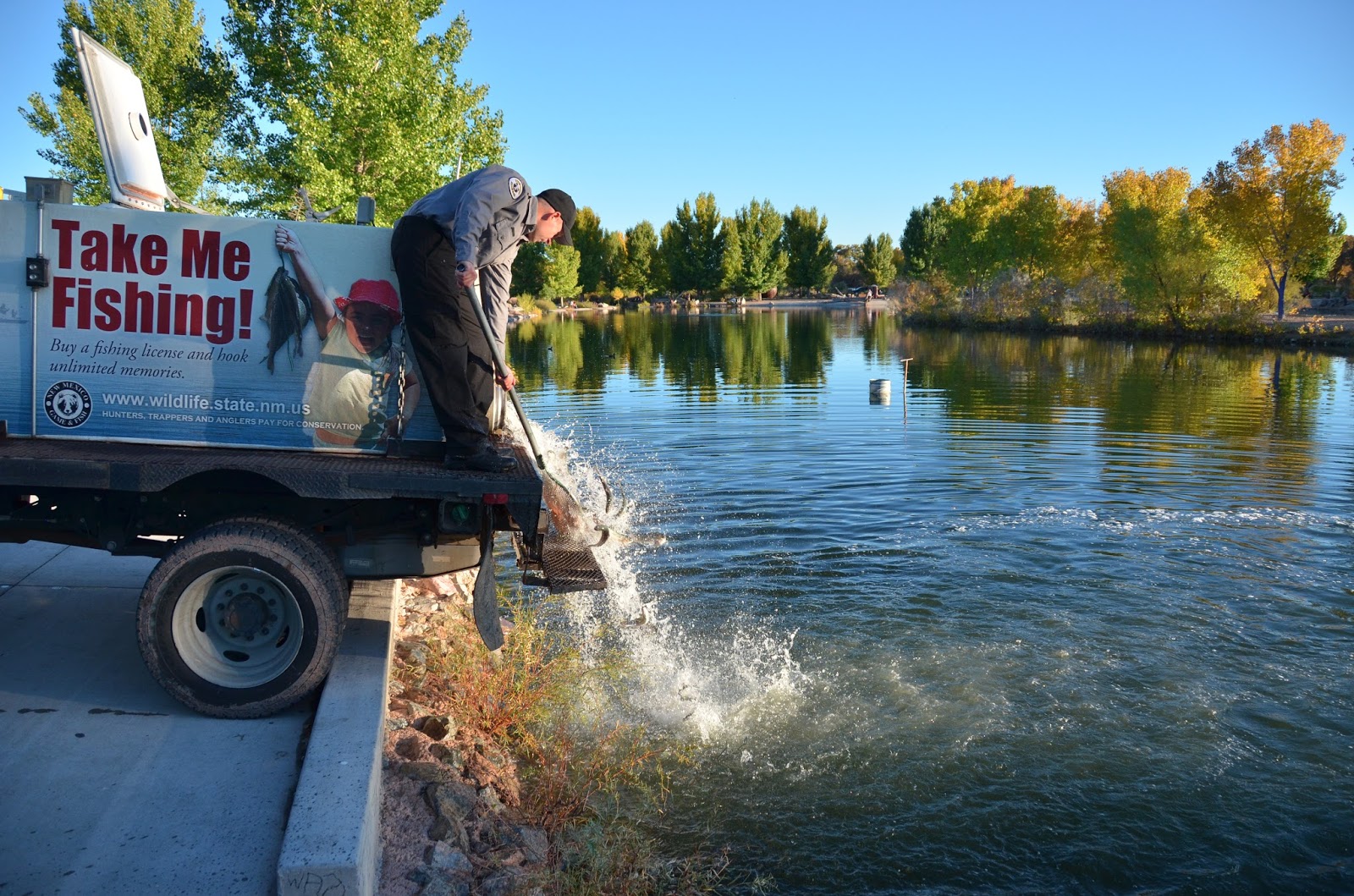
Trout stocked all winter long to satisfy New Mexico anglers


Anglers can still catch plenty of tasty fish during the winter as the New Mexico Department of Game and Fish switches from stocking catfish to trout in many statewide waters.

Every fall, the department switches from stocking catfish in the summer to trout in the winter at Tingley Beach, the Albuquerque area drains and other popular fishing waters in the southern half of the state.

“Trout fishing in small community ponds in southern New Mexico is especially popular during the winter," says Dan Williams, spokesman for the New Mexico Department of Game and Fish.

Lake Van near Dexter southeast of Roswell is a popular winter fishing destination. 
Catfish thrive in warmer water while trout prefer it much cooler, and these waters are ideal for this kind of stocking program.

Rainbow trout, including some big ones, are already being stocked at multiple locations in the drains that run alongside the Rio Grande

Larger trout are frequently added during routine stocking to provide anglers even more fun while fishing.
"We’re fortunate here in New Mexico to have waters such as Tingley Beach and the Albuquerque-area drains that cool off enough in the winter to allow us to stock trout for anglers to catch,” Williams says.

Although the department doesn’t disclose exact stocking spots, general locations include: N.M. 550 river bridge in Bernalillo, the Corrales drain along the bosque, and the Rio Grande Open Space off Alameda Boulevard

Other stocking spots include the Shining River parking area, the drain between Bridge and Rio Bravo Boulevards, and the west bank of the Belen drain and the east bank of the Peralta drain between Los Lunas and Belen. 

Maps of the drains areas can be found in the fishing section of the department’s website at www.wildlife.state.nm.usThousands of trout are stocked every week from November through March. See the weekly stocking report on the department’s website for details of when and where.

Albuquerque anglers say fishing for trout in the drains requires some stealth and typical fishing techniques. Check out YouTube for some great videos of folks fishing for trout and bass in the Albuquerque area drains.

Trout in the drains usually can be found in deeper pools, under the shade of overhanging trees or around any kind of protective structure. 

Prime trout habitat on an Albuquerque area drain.
Try using a salmon egg or worm on a short piece of lightly weighted line just below a bobber or bubble so the bait rides just above the bottom. Spinners and flies are good lures too.

Most areas along the drains are open to the public during daylight hours and can be accessed by walking, riding a bike or driving if permitted.  For more information about riverside recreation in the Albuquerque area, visit the city’s website at www.cabq.gov.

A quiet afternoon of fishing along one of the Albuquerque area drains.
At Tingley Beach, anglers will find a kids pond for anglers younger than age 12, a central pond where bait is allowed and the bag limit is four trout per day. There is also catch-and-release only pond where only single, barbless hooks on artificial flies and lures may be used.

Kids enjoy some fishing at one of the ponds at Tingley Beach.
Anglers ages 12 and older need a current fishing license. Call the department’s customer service line at (888) 248-6866 to immediately get one. A license also can be purchased online at www.wildlife.state.nm.us or from vendors such as bait and tackle shops and sporting goods stores.

Tingley Beach, also called Conservancy Park, is operated by the City of Albuquerque and features a café, restrooms, hiking and biking trails and security guards on patrol. See the city's website for more information.

Good winter trout fishing also can be found within a moderate drive from Albuquerque, including the Pecos River at Sumner Lake and Villanueva state parks. Anglers can wet a line for trout at Escondida Lake just outside of Socorro or on the Rio Grande below Elephant Butte Lake at Truth or Consequences. 

The Pecos River below Sumner Dam is well stocked with trout during the winter.
Anglers will find plenty of well stocked winter trout fishing waters in the southern part of the state. For a list of those waters visit the department’s website at www.wildlife.state.nm.us. Most of the state's best fishing can be found at state parks. Visit their website for more information. 


Tuesday, November 07, 2017

Salmon Snagging Slow in 2017

A few die-hard salmon snaggers brave the cold wind and slow fishing at Navajo Lake in mid-October.
Northern New Mexico's salmon snagging season has gotten off to a slow start with anglers reporting much fewer fish being caught this year.

"Some locals had a little luck  a couple weeks ago but its been real slow since," said Mike Bowman, park ranger at Eagle Nest Lake State park.

And anglers interviewed at Navajo Lake in mid-October also reported reduced catches.

That leaves Heron Lake where long time fishing guide Don Wolfley reports that salmon stocks have been way down over the past several years.

"It's been terrible," he said. "I haven't guided in three years now."

The snagging season at Heron Lake opens on Friday, Nov. 10, and it remains to be seen how well anglers will do.

"We've been expecting the populations to be pretty low," says Eric Frey, sport fish program manager for the New Mexico Department of Game and Fish.

Kokanee Salmon are stocked in these northern New Mexico reservoirs where the cold deep waters produce plankton upon which the fish can feed.

The fish are landlocked, sockeye salmon that upon reaching sexual maturity, usually at the age of about four years old, will mass in schools during the fall in a futile effort to spawn.

Because salmon typically need a river and other proper conditions under which to reproduce, these spawning fish will not enjoy much success.

Then they’ll begin to die which is And why the department created a special snagging season to allow anglers to catch and keep up to 12 salmon a day.

An angler shows off a salmon he caught at Navajo Lake in 2015.
Heron Lake's salmon snagging season is delayed to allow state Department of Game and Fish personnel time to trap and milk spawning salmon for their eggs and sperm.

The collected eggs are fertilized, sorted and then reared at the department’s nearby Los Ojos Fish Hatchery so they can be used to restock the state's deep water lakes with the popular sport fish.

The salmon stocking program is very dependent upon the annual salmon milking operation at Heron Dam to produce more fish.

But several years drought, low reservoir levels and poor water quality have harmed the salmon population and much fewer eggs have been collected, Frey said.

The department is obtaining additional eggs from out of state this year and hopes to have a decent amount of fry to replenish populations.

Wolfley says he guardedly optimistic that Heron Lake's salmon population will rebound sometime in the next few years so he can return to guiding.

In the meantime he expects the die-hard salmon snaggers to turn out on opening day at Heron Lake if for nothing else than to have a good time with family and friends.

Don Wolfley


Thursday, September 14, 2017

Lagunitas Lakes Make for Fine Fall Fishing


By Karl Moffatt

New Mexico’s long, hot summer is finally over and abundant monsoon rains have created a lush landscape for us to play in this fall.

Many would argue that autumn is the best time of year to get outdoors and enjoy all that the state has to offer.

The days are pleasantly warm and sunny while nights are crisp and cool. Gone are the summer’s tourist crowds and it is a time locals savor.

And with the drought officially over for the first time in 18 years many of the region’s lakes, rivers and streams are primed for outdoor recreational pursuits.

So whether it’s hiking, camping, fishing or sightseeing there’s plenty of great places to visit and enjoy during northern New Mexico’s most spectacular season.

One great fall destination that provides all of the above in a remote, backcountry setting is Lagunitas campgrounds in the Carson National Forest just outside the Cruces Wilderness Basin.

The remote campgrounds feature a couple of small, well stocked trout ponds surrounded by open meadows and stands of aspen and pine trees.

The 25 mile drive on Forest Road 87 to the campgrounds is worth the trip alone. It’s found just off U.S. 285 about 10 miles north of Tres Piedras.


The well maintained road winds its way along San Antonio Creek before climbing to a plateau offering panoramic views of the surrounding countryside.

Note the intersection of Forest Road 87A as this is the turnoff to the Los Pinos River and an alternative return route that comes out near Antonito, Colo.


Proceed into the woods and proceed to the lower campground to find a cinderblock outhouse and campsites amid the pines by the ponds.

Visitors may be curious about the charred remains of a building back in the trees and a concrete slab where a U.S. Forest Service once stood. See Otter Olshansky: A Lonely Death on New Mexico's Continental Divide Trail to learn more about what happened here.
Visitors to the campgrounds in the fall may encounter cattle roundups, continental divide trail hikers and bikers, wildlife, hunters and spectacular fall foliage.


The campgrounds are officially open June through October but remains accessible year round depending on the weather and road conditions. Anyone venturing into the backcountry to during the off season is asked to check in at the Tres Piedras Ranger station and let them know. Dispersed camping also is available throughout the area. For more information try contacting the Tres Piedras Ranger District at (575) 758-8678.

When traveling through Tres Peidras support the local economy by stopping at the Chile Line Depot. They serve great burgers, breakfast burritos, coffee and baked goods and are providing travelers a valuable service on what is otherwise a very long, lonely stretch of rural highway. We love this place, check them out at www.chililinedepot.com.

For other suggestions about where to go in New Mexico to enjoy fall camping and scenery see some of our previous articles at Fall is a Great Time for Camping in New Mexico and Visit the Valle Vidal for Great Fall Scenery and Throw a Cruise by the Brazos for Best Fall Colors.

Popular Posts