Tuesday, November 23, 2010

Longtime Fly Fishing Guide and Noted Author, Van Beacham, Offers Fall Fishing Tips

Van Beacham relaxes by the John Dunn Bridge on the Rio Grande one fine, fall, day .
By Karl Moffatt
If it’s fall and you fish, it’s time to be on the Rio Grande enjoying a warm sunny afternoon chasing hungry trout on the state’s big river.

“It’s the optimal time of year to be fishing the Rio Grande and its tributaries,” says Van Beacham, a longtime Taos area guide and author of “Flyfisher’s Guide to New Mexico.” “The weather is ideal, there’s not too much wind, it’s sunny and warm and the fish are active, trying to fatten up for the winter.”

And unlike much of the fishing season when fishing is best in the morning and evening, fall fishing is best done later in the day when the water has warmed up and the bugs come out.

“It doesn’t get any better than this,” says Beacham, 52, of San Cristobal, as he shares some fall fishing tips during a recent outing to the John Dunn Bridge on the Rio Grande just north of Taos.

Beacham comes from a long line of “fishing bums” and has been showing his clients the trick to fall fishing since he opened his first guide and fly shop in Red River back in 1983.

Beacham says the Rio Grande is most productive when fished with a streamer or spinning lures in the fall as these potentially bigger meals are much more appealing to hungry fish.

The Rio Grande, a big river lined with volcanic rock, is notorious for skunking anglers who fish it with traditional flies and nymphs.

And that’s because the fish have so many hiding spots down among the underwater rocks that getting their attention with such a small lure can be extremely difficult.

However, a twitchy streamer or flashy spinning lure is more apt to be seen and chased by hungry trout in the Rio Grande, Beacham says.


Beacham says there are no real rules to streamer fishing, the lure can be fished upstream, downstream or across with a fast, slow or balky retrieval. It can even be jigged along the bottom with an up and down motion.

“The key is to keep it moving and the rod tip low to the water,” he said. “And never stop retrieving until you can see the lure, it’s amazing how many times a fish will follow it right up to your feet.”

Streamers like wooly boogers and sculpzillas in olive and black and sizes 2 through 8 are good to have on hand and a good rod for the Rio Grande is a nine-foot, five or six weight.

When casting these bigger lures fly anglers need to adjust their technique to accommodate the extra weight. When retrieving the line, the angler strips it in with short bursts at various lengths using the free hand.

Strikes will be fast and hard and setting the hook requires an additional strip of the line, Beacham says.

The Rio Grande supports wild rainbow, brown and cutbow trout that reach sizes up to 20 inches or more, Beacham says. And pure strain Rio Grande cutthroat, trout have also recently been reintroduced to the river in an attempt to reestablish the state fish in its traditional, native, habitat.

Beacham advises those venturing down to the Rio Grande at locations such as Pilar, the John Dunn Bridge and the Wild Rivers Scenic area above Questa to avoid wearing felt-soled wading boots because of the slipperiness of the riverside rocks.

Anglers need to drink plenty of water, carry some basis survival needs such as matches, a space blanket and energy bars. They should dress in layered clothing such as a fleece jacket and a nylon shell and let someone know where you’re going as these are remote and potentially hazardous areas.

Those seeking a quieter afternoon’s angling might want to pass up the streamers and stick to nymphs and dry flies on any number of creeks feeding the Rio Grande that also fish well in the fall, Beacham says.


Streams like the Arroyo Hondo, the lower Red River and the Cimarron below Eagle Nest Lake all offer anglers good fall fishing for feisty trout on traditional tackle such a 8-foot, four weight rod armed with a short leader and a couple of flies.

Beacham recommends using a mayfly nymph tied up like a gold-ribbed hare’s ear, but in olive instead and without the gold rib. The fly can be rigged with a bead head or flashback in sizes 12 through 22.


Hung below an attractor pattern, such as an egg or worm, this can be a deadly combination when dead drifted through a pool or riffle.


And if bugs begin to hatch on the water then a size 18 to 22 olive colored or parachute Adams dry fly will usually suffice to attract a surface strike from a hungry trout most fall days, Beacham says.

Beacham says when anglers are failing to catch fish with nymphs, most of the time it’s not the fault of the fly but the size of the weight and the length to the indicator.

The nymph should be bumping along the bottom and if it’s not, either the weight should be increased, the strike indicator moved up or a combination of both. If the fly is dragging then the opposite would apply.

Successful nymph fishing requires a dead drift and good line control and one means of achieving that it to learn to high stick, a method Beacham spells out along with numerous other tips in a section of his book called Small Stream Techniques.


Beacham’s book, the second edition of which was just released with updates and a new section on pike fishing on the Rio Grande, is comprehensive in providing not only detailed information of where, how and when to fish New Mexico’s many different waters but also in providing important tips on what gear to use, additional equipment and handy packing lists.

When he’s not out fishing Beacham, who is single, enjoys dancing to western swing music and taking in the diversity of Taos’ music and restaurant scene.

Born one of three brothers and a sister to William and Jo Ann Beacham of Santa Fe in 1958, Van Beacham says he was warned as a teenager that he was doomed to be yet another one of the Beacham family’s notorious fishing bums.

“My dad warned that I’d better find a way to make some money doing it cause that’s how I was going to end up,” Beacham says.

Beacham’s great grandfather, William Beacham, was the first to sell fly fishing tackle from his hardware store in Santa Fe and sired a son who became a notorious fishing bum.

Another one of his elders, John Bengard, was the superintendent of fish hatcheries in New Mexico and designed the Lisboa Springs trout rearing facility near Pecos, Beacham says.

His grandmother was the trout hatchery superintendent’s daughter and his grandfather the fishing bum born to the hardware and fishing tackle store owner.

Beacham credits his dad, who also loved to fish, with teaching him the solitary sport at an early age.

“My earliest recollection of fishing is of him sticking a bamboo pole in my hand, a worm dangling in the water and telling me not to move,” Beacham says. “This was somewhere up on the Rio Grande.”


Later as a teenager living in Pecos where his dad was working with the state highway department, Beacham found himself frequently fly-fishing on the Forked Lightning Ranch, now in the hands of the National Park Service.

Beacham attended the Vo-Tech high school in Santa Fe where he was schooled in electronics, graduated in 1976 and first worked at Eberline Instruments, one of Santa Fe’s few industrial businesses in the factory now standing empty on Airport Rod.

Beacham tried attending an advanced electronics school in Arizona but bailed after a few months and found himself in Jackson Hole, Wyo., working as a dishwasher, shuttle driver and finally a fishing guide.

Upon his return to New Mexico his dad cashed in a life insurance policy he had taken out on his son, the fishing bum, and loaned him the money to start up his first fly shop and fishing guide service.


Beacham now provides guide services throughout northern New Mexico, southern Colorado and Wyoming and also offers membership in his private fly fishing club with leased access to private waters in all three states. See his website at www.solitaryangler.com for more information.

Sunday, November 07, 2010

Trophy Tiger Muskies in Quemado, Bluewater Lakes make for Amazing Angling

Matt Pelletier of New Mexico Muskie's Inc at Quemado Lake, Fall 2010.Photo courtesy of Pelletier.
By Karl Moffatt
It’s New Mexico’s latest fishing craze, anglers trying to catch giant, 40-inch, 20-pound tiger muskies lurking in the depths of Quemado and Bluewater lakes where they’ve been stocked to prey upon undesirable fish.

“People are coming from all over the place to catch these,” says Matt Pelletier of New Mexico Muskies Inc., a newly formed, non-profit club, dedicated to the sport. “And it’s a real rush when you get into one.”

The predators, a cross between a muskie and a pike produce a sterile hybrid that can be raised in hatcheries and then stocked in lakes to help control undesirable fish populations.
 A tiger muskie falls victim to an imitation goldfish lure.
The New Mexico Department of Game and Fish (NMDGF) has been stocking tiger muskies in Quemado and Bluewater lakes for the past several years to rid these waters of increasing populations of white sucker and goldfish.

These kinds of undesirable fish compete with sport fish, like trout, for the available habitat which in turn leads to reduced angler satisfaction at these locations. At one point Quemado Lake was virtually overrun with goldfish and trout fishing was almost nonexistent.

But the stocked tiger muskies have gone about their deadly work for several years, chasing down and eating their intended victims and some anglers have since turned to catching them, strictly on a required catch and release basis.

But the tiger muskies have done such a good job in reducing the undesirable fish populations at both lakes that the state Game Commission has recently ruled that anglers can now catch and keep a trophy size tiger muskie from either lake.
 Tiger muskies under 40-inches length have to be returned to the water.
For example, Quemado has seen its goldfish population diminish considerably as revealed during an August, 2010 NMDGF survey that picked up 34 goldfish an hour during electro-shocking. In 2008 the number was 157 goldfish an hour while in 2006 the number was much higher at 377 goldfish an hour, according to the NMDGF’s coldwater fisheries biologist, Richard Hansen.

Surveys results lead researches to believe that Quemado Lake holds a population of about 1,100 Tiger Muskies over 18-inches in length. During the fall electro shocking survey 30 tiger muskies were netted with the average size coming in at 33-inches and the largest weighing in at 19-pounds and 43-inches in length.

During the same survey 62 trout were caught with the average size being 18-inches indicating the popular sport fish is thriving in Quemado Lake despite the addition of larger predators to the environment.
 The trout have returned to Quemado Lake.
Pelletier says that’s because the tiger muskies like to eat exactly what they were introduced for, the goldfish and suckers.
That’s good news for trout anglers who in recent years may have given up on Quemado Lake.

An early November trip to the lake on a warm sunny Saturday revealed good fishing with several young tigers netted along with a trophy sized trout and a giant grass carp.
 A monster carp inadvertently hooked while trolling at Quemado Lake.
Bluewater Lake enjoys similar results and plenty of tiger muskies to be caught.

Pelletier says his organization was formed to help educate anglers about the sport and assist the state in improving, protecting and promoting the tiger muskie fisheries.

For instance, the club raised $5,400 through a grant from the Hugh C. Becker Foundation to purchase minnows to feed tiger muskies being reared at the state’s Rock Lake Fish Hatchery. This helps keep the young predators from preying on each other while raised at the hatchery.

The club boasts 56 members, welcomes new anglers and meets about once a month in the Albuquerque area. The meetings are open to the public, Pelletier says.

Anglers wishing to fish for tiger muskies should be aware of some special equipment needed to do so successfully.
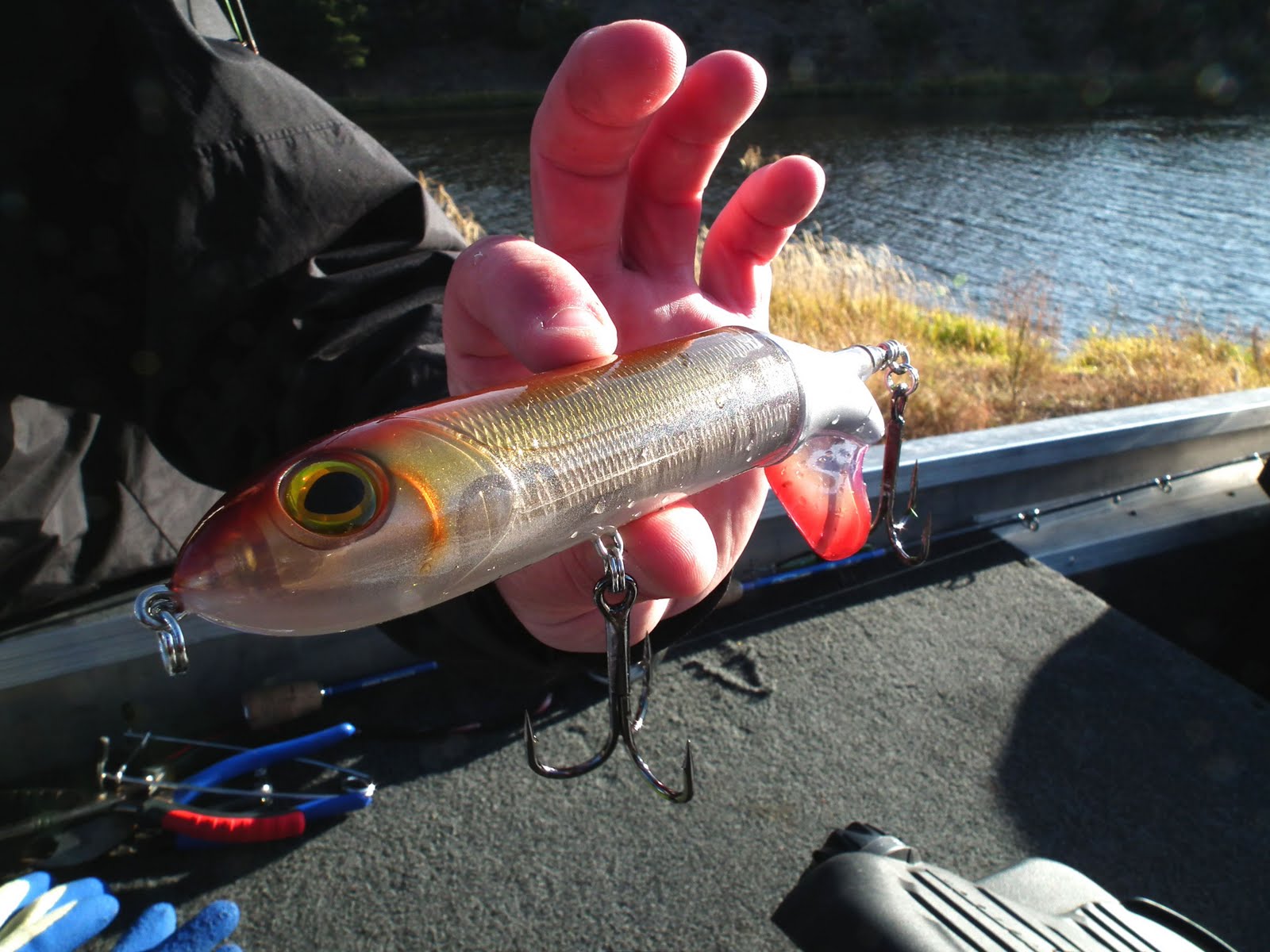
 Tiger muskie lures come in all shapes and sizes.
Anglers will need at least a seven foot long, heavyweight rod capable of handling at least a 20-weight line an one ounce lure with an open face spinning or bait casting reel. Wire leaders are recommended and typical lures would include jerk baits that resemble goldfish, suckers and perch.

Anglers should be equipped with a pair of long, needle nose pliers for dislodging hooks. A pair of heavy nippers for cutting hooks off if needed and a pair of jaw spreaders to open the fish’s mouth and get at embedded hooks.
 Tiger muskie should be handled with extreme care due to their teeth.
A very large net or preferably, a sling net, in which the fish can be cradled in the water is a necessity for handling the fish properly without harm to itself or the angler.

“We practice and preach catch and release to conserve the resource,” Pelletier says.

Those fishing for tiger muskies need to practice patience and persistence as the fish feed on a limited schedule and anglers need to have their lures in the water when that occurs, Pelletier says.
 A boat is nice but most tiger muskies are caught right from the bank, Pelletier says.
Tiger muskies have a slow metabolism and after a good sized meal may not eat again for some time which accounts for their sporadic feeding behavior.

The key to attracting a strike from a tiger muskie is to capitalize on its opportunistic, predatory instinct with jerks and motion of the lure that imitate a wounded or struggling prey, Pelletier said.

For more information about the fish, catch and release techniques and some awesome photos check out the club’s website at http://www.newmexicomuskiesinc.org.
 An Osprey enjoys a fish snatched from Quemado Lake and is another sign of a healthy fishery.

If You Go: 
From Santa Fe take I-25 south to I-40, head west to exit 89 and NM 117. Head south through the Malpais, taking time to stop and check out the BLM visitor center, the natural arch and the black lava flows. Follow this lonly stretch of blacktop down to NM 36 and on to Quemado. Head west on US 60 a short distance past town and then take NM 32 to the turnoff to Quemado Lake. Campsites with restrooms are available in the forest on the far side of the lake off Forest Road 103.

For an alternate route home, don't leave the way you came in, instead keep going past the the lake on Forest Road 13, up across Slaughter Mesa and then drop down off the mountain onto Forest Road 218 which leads to State Highway 12.  Follow the highway to the intersection of US 60 at Datil. There's a bar, cafe, general store and gas to be had here. Follow US 60 past the very large array to Magdalena and on to Socorro and I-25 north to Albuquerque and Santa Fe. A very scenic drive and then a quick ride home on the interstate.
 The Very Large Array on the Plains of San Augustin.


Sunday, October 24, 2010

Fisher-Chick, Clarissa Lopez, Shares Fishing Tips, Top Spots and Great Gear

By Karl Moffatt
Got fat, lazy, kids dominated by cell phones, captivated by video, stupefied by TV?

Maybe it’s time to drag them out of the house and teach them one of New Mexico’s favorite outdoor pastimes, like how to fish, the old fashioned way, with a simple pole and some bait down at the local fishing hole.

If so, then Espanola author and angler, Clarissa Lopez, has got the fishing guide book for you. Simple, easy to understand instructions on how to cast, fish, use bait, handle a fish and more importantly, where to go!

Featuring dozens of family friendly fishing spots in northern New Mexico and southern Colorado, this guide makes getting out there a breeze and teaching kids to fish, effortless.

Lopez, 53, of La Mesilla, is one of three sisters and a brother born into a traditional Hispanic family living on a small family farm by the banks of the Rio Grande near Espanola.

Her father, Henry, a Jemez Electric Cooperative worker, passed down to her the simple joys of fishing, camping and playing outdoors by taking her on trips up into nearby Santa Clara Canyon and other nearby spots.

But many of today’s kids seem to lack the same experiences and may be missing out on some of the simpler joys in life like playing outside in the sunshine and learning about and respecting nature, she says.

So Lopez set out to pass down some of those old fashioned fishing skills along with some insider tips on where to go so that anyone can enjoy a day of fishing and relaxing in the great outdoors.

Her self-published book is titled “Fisher-Chick. A female view of family fishing in Northern New Mexico and Southern Colorado for good old fashioned fun bait fishing.” It was 2009 finalist for the New Mexico Book Awards and can be purchased online from her website at www.fisher-chick.com.
Inside, readers will find detailed instructions on how to reach 20 good, fishing locations including legendary northern New Mexico fishing spots like Canjilon Lakes, the Rio Chama, the Rio Brazos, Hopewell Lake and Lagunitas.

Lopez offers her own insights about fishing including why she does it and why others should too. She remarks that kids should never be “skunked” when fishing and one should not suffer a “cardiac” while getting there, hence the use of live bait and easily accessed waters.

And while Lopez thinks highly of worms and grasshoppers for catching fish she’s not above tossing one of her handmade, spinning lures armed with a single barbless hook into a steam governed by special restrictions.

Lopez is married to Rick, a retired Los Alamos Lab employee who has two sons, and they love to eat fish.

But Lopez preaches catch and release and uses barbless hooks or pinches the barbs on hooks simply because it makes releasing fish she doesn’t want to keep that much easier to release.

Lopez stresses the need to pick up and pack out trash to protect public lands for the future enjoyment of others. However she sees no need for further road closures in our national forests because it impedes access to the backcountry.

Her attitude is the government should simply abandon the roads and let people figure it out on their own.

Lopez, who also works at the Labs, offers tips on how to grow a good worm supply in your own backyard and how to collect and store grasshoppers for use.

She offers her experience that nothing works like a live hopper for eliciting a hard strike from a trout but in a minor oversight fails to note exactly how to impale one on a hook.

“Through the belly so the hook faces forward, that way it won’t come off when you’re casting,” she says. “It’s kind of icky.”

Lopez’s book contains handy packing lists for fishing and camping with the item “beer” dominating the top of the food category list and beans included at both lunch and dinner.

She illustrates with pictures how to tie on a hook using a loop to loop connection, offers tips on casting and fishing including her recommendation to use a closed face, spin caster for simplicity’s sake.

She uses nearly indestructible PVC pipe with removable end caps to store and transport her rods too.

And perhaps the best piece of advice her book offers is that upon showing up at the fishing hole one should immediately inquire of other anglers as to what they’re biting on.

Reading Lopez’s book is like spending a couple hours lakeside with an old timer, listening as he or she passes on knowledge and advice on how to fish and other related matters.

A visit to her site will reveal a collection of handmade lures for sale including the single, barbless, spinning lure in two weights, a real find for anyone who wants to fish quality waters like the San Juan River with a spin caster.
The site also boasts fishing lures made from discarded beer bottle caps, traditional treble hook, spoon spinning lures and a handy, foam hook caddy. There’s even forage caps sporting the Fisher-Chick logo.

Lopez says she’s not out to make a killing selling her wares but more interested in promoting the sport and lifestyle of traditional bait and lure fishing so that others can enjoy what many Nortenos already know.

Sunday, October 17, 2010

Ortiz Mountain Ranch, Great Views, Stellar Hiking, Plenty of Wildlife But Should We Buy It?

Larry Brow of Azure Enterprises at Ortiz Mountan Ranch October 2010.
By Karl Moffatt
Its peaks dominate the skyline, running like a roller coaster across the eastern horizon and creating a mesmerizing vista for motorists traveling along the Turquoise Trail scenic byway.

It’s about 12,000 acres of rugged mountain land dotted by pinon and juniper trees with incredible views, abundant wildlife and the fleeting possibility of public ownership.

Located just outside of the funky little town of Madrid, the Ortiz Mountain Ranch served as the summer home for the family of Edmund F. Ball of Muncie, Indiana.

An heir to the Ball family industrial dynasty, makers of the famous canning jars, Edmund Ball, told the now defunct Crosswinds weekly, in a 1997 article about New Mexico’s largest land owners, that he wanted the ranch preserved as natural habitat “forever.”

Ball loved the West, enjoyed being a gentleman cattle rancher and upon his death in 2000 at the age of 95, left the Ortiz Mountain Ranch to the Nature Conservancy.

Ball wanted the property preserved as open space and his surviving family members hope his wish is fulfilled.

“I think in particular he’d have wanted it made into a state park,” said his son, Robert Ball, 57, of Traverse City, Michigan.

The ranch land is protected by a conservation easement which prohibits any housing subdivisions or industrial uses such as sand and gravel mining in exchange for substantial tax benefits.

Robert Ball said he remembers fondly the summers he spent working as a ranch hand on the property south of Santa Fe off State Road 14.
The view to the northeast of Santa Fe from the Ortiz Mountain Ranch.
“So I hope it is put to good use,” he said.

Ball’s mother, Virginia, was also interested in conservation and served on the board of the National Wildlife Federation, he added.

Ball’s father was a WW II veteran who earned the Bronze Star while serving as an Army officer during military campaigns at Anzio, Salerno and Sicily. He was also a pilot who flew high performance aircraft regularly and served on numerous boards including the Public Broadcasting Service (PBS).

Now, his beloved ranch is in the hands of the Nature Conservancy, a national non-profit organization dedicated to preserving natural resources, while the ranch house, sitting upon a section of land, 640 acres, is still owned by Ball’s heirs.

Both properties, the ranch house and ranch land, are being sold through separate brokers with the ranch listed by Azure Enterprises at $3.4 million while the ranch house and surrounding acreage is listed with Margo Cutler at $1.3 million.

Gov. Bill Richardson’s administration was able to secure a deal to purchase both pieces of property on behalf of the state for a little over $2.9 million, according to Jodi McGinnis Porter, spokesperson for the state Energy, Minerals and Natural Resources Department (EMNRD).

The Richardson administration proposed purchasing the park with federal stimulus dollars for expansion of the newly created Cerrillos Hills State Park just outside the historic mining town of Cerrillos and for use as a wild horse sanctuary.

The acquisition would help support the local economy, promote tourism and provide hiking and other recreational opportunities to the public, according a press release touting the purchase.

And as noted by Jim Noel, Secretary of EMNRD, in an op-ed he wrote for www.nmpolitics.net, buying the ranch at less than $230 an acre is a “tremendous deal” for the state and future generations of New Mexicans will be thankful for it.

But the deal has apparently hit a snag due to public outcry over the use of federal stimulus dollars for the purchase while other worthy projects, such as the Cumbres and Toltec Scenic Railroad’s burned out and yet to be repaired railroad trestle in the tourism town of Chama, remains underfunded.

The purchase was slated to go before the state Board of Finance for approval in September but has since been taken off the agenda and McGinnis Porter, of EMNRD which oversees state parks, declined to comment when asked about the current status of the ranch purchase.

The purchase is opposed by gubernatorial candidate Diane Denish, who is Richardson’s lieutenant governor and a member of the state Board of Finance.

In the meantime the property continues to sit unused, off the sides of State Road 14, just up the hill from Madrid and seeing it makes for a wonderful daytrip.

During a recent visit with real estate broker, Larry Brow of Azure Enterprises, it became apparent that the ranch would provide the visitors to the area with a welcome stop along the scenic and very lonely back road to Albuquerque.
Larry Brow of Azure Enterprises and his partner Dave Makowski look west from the  Ortiz Mountain Ranch.
With sweeping views of the Rio Grande Valley, the Jemez Mountains to the West and even Cabezone Peak far off in the distance, one can only imagine what it would be like to camp on the upper reaches of the 8,000-foot mountains here.

Looking back towards the north and east towards Santa Fe, one is presented with an amazing view that rivals anything that can be found in the region.

Brow said because the ranch has been unused for many years it has become home to a good population of mountain lions, black bear, eagles, hawks and other creatures.

“It’s essentially a wildlife sanctuary now,” Brow said.

The ranch features a year-round free-flowing spring and is also watered by several windmill operated wells, Brow said.

Looking out over the landscape from these mountains it is easy to see why the Ball family found it such a refuge and how the public might, too.

If You Go:

Take Cerrillos Rd. to State Road 14 to Madrid, continue through town up a hill and upon descending the other side look for the intersection of County Road 57A heading west towards Santo Domingo Pueblo. The highway here runs through ranch property with a smaller section on the west side of the road and the larger tract, including numerous mountains peaks, on the east side. No trespassing permitted.

Sunday, October 10, 2010

Albuquerque International Balloon Fiesta - What a Gas!

By Karl Moffatt
Lightning flashed in the pitch black sky as we raced south on the interstate to the balloon fiesta in Albuquerque.

It was five in the morning and we couldn’t see what the weather was doing, all we knew was it smelled like rain and there was one hell of a light show on the western horizon.

We arrived at the Park-And-Ride area at the Santa Ana Star Casino with plenty of time to spare, it was only forty miles from the Southside of Santa Fe and a quick drive on the nearly empty highway.

We piled into a school bus loaded with plenty of others who’d gotten up early to participate in New Mexico’s annual fall attraction, the world’s premier, hot air ballooning event.

In the predawn darkness we huddled in the bus as winds whipped rain against the windows and listened as a local broadcaster spoke over the bus radio about the weather front passing through the area.

“Don’t worry, think positive and it’ll be fine” my wife said as I shook my head.

She was right.

We rolled into town along an empty back road and slipped like a presidential motorcade through traffic backed up at the balloon park.

Within minutes we were inside and on the field.

No hassles with parking or traffic and the cost of admission was included in our $10 bus ticket.

This was the only way to go.

And the weather front had passed through quickly after whipping up things on the north side of town.

The wind and rain was now gone and as the sun rose over the Sandia Mountains, the balloons began to rise.

First one and then another filled with hot air, fueled by roaring propane burners, the big colorful envelopes, rounding out and stretching for the sky.

Crowds of onlookers moved among the balloon crews, almost every one armed with a camera of some kind.

It is the most photographed event in the world, according to its promoters.


It is truly a one of kind, interactive experience as spectators become part of the scenery, mingling on the field as crews raise their balloons and depart.

Some 500 balloons from all over the world will typically take off in a mass ascension while as many as 100,000 onlookers gaze skyward from the grounds of the city’s 78-acre launch field.

But today many balloons remained grounded due to high winds in the upper atmosphere.Others though braved the conditions and float up and around at lower elevations.

Despite the flight limitations, crews filled their balloons to provide the crowd with the spectacle of sight, sound and color that they had come for.

The weather had played its hand again, forcing cancellations of some events as it has throughout the week.

Windy conditions and spotty rain in the evenings put a damper on some of the scheduled evening festivities including the hugely popular balloon glows and fireworks shows.


But the weather is all part of the experience and when it holds and the conditions are right, there’s nothing like standing on a field of grass with thousands of other people watching hundreds of aerial monuments take shape and slowly rise from the earth to our delight and amazement.

And when it’s all done by mid morning, it’s time to walk the midway in search of those special mementos and treats that can only be found amid a carnival atmosphere like this.

Breakfast burritos abound while turkey legs and pizza can also be had, too. There are beer gardens and musicians,knife jugglers and donut hawkers.


There are shops that sell football paraphernalia, hats and clothing from South America, souvenir pins, playing cards and apparel commemorating the balloon fiesta and many other items too.

But it’s the crowds of people milling about that provides a whole other show of colors, sights and sounds.

Foreign voices abound with local Indians speaking in their native tongue while tourists from overseas and down south wander about chatting excitedly in their own language.

Young kids in grunge mingle among neatly attired baby boomers while balloon enthusiast’s show off their pins with wacky, colorful, balloon shaped hats.


And everyone seems to be grinning.

There among the crowd comes a man wearing an Assumption College sweatshirt and I have to stop him and say hello.

“Hey I’m from Boston,” I told him. “We used to all pile in a car and cruise out to Worcester to chase the girls out there at Assumption. We’d party all night and then go eat big plates of baked Ziti down at the Boulevard Diner, you know the place?”

"No,” he told me with a squint, “It's my daughter who goes to school there.”

“Oh yeah,” I say trying to move on from my folly. “Hey, how about those Jets, eh?”

We find our bus and leave the balloon field behind, rolling through the north valley past the bronze colored pastures, the copper tinged cottonwoods of the Bosque and under our famed blue skies.

We yawn and wonder aloud what we'll do with the rest of the day, one that for many people has just gotten started.

Popular Posts