Sunday, September 23, 2012

Record Breaking, Trophy Sized Tiger Muskies at Bluewater Lake

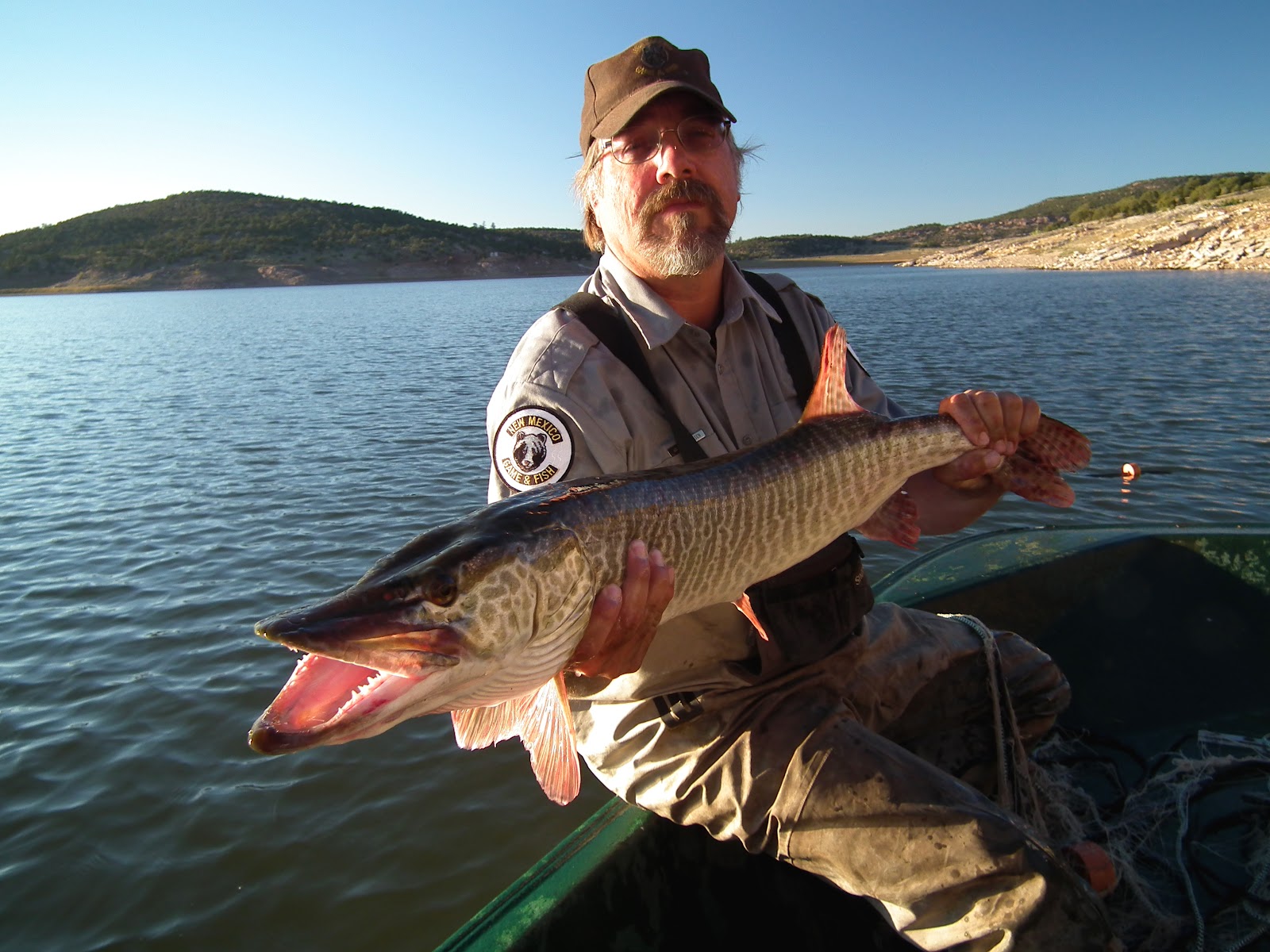
New Mexico Department of Game and Fish (NMDGF) Conservation Officer, Travis Nygren, shows off one of the giant tiger muskies found at Bluewater Lake in western New Mexico.
The Tiger muskie fishing at Bluewater Lake is so good these days its drawing anglers from across the state looking to land a trophy sized fish and maybe even break the state record.

“It’s crazy out here,” says Rodney Busch, 28, of Bluewater Village who frequently fishes the lake near his home. “There’s people coming from all over, even out of state, just to catch them.”

The state record has changed hands four times in just over a year and is currently held by Marcos Mata of Albuquerque after he snared a monstrous 50.5-inch, 38-pound, 2-ounce muskie at Bluewater Lake in July using a two-inch, silver, artificial minnow.
Bluewater Lake as seen from an overlook in the state park high above the water.  
Prior to Mata’s catch the record was held by a guy from Edgewood who had taken it from a Truth or Consequences fisherman who had snagged it from an Albuquerque angler, according to state Department of Game and Fish records.

All took their record catch from Bluewater Lake in western New Mexico.

The International Game Fish Association’s North American record is for a 51-pound, 3-ounce tiger muskie caught at Lac Vieux-Desert, Mich. caught in 1919.

At the rate record catches are being recorded at Bluewater Lake someone could possibly take the national record too.

Tiger Muskie records are measured by weight not length.

Tiger muskies were planted in Bluewater and Quemado lakes back in 2003 by the state Department of Game and Fish (NMDGF) to get handle on a population explosion of unwanted white sucker and gold fish.

These undesirable “trash” fish compete for limited resources with “sport” fish such as trout and in both lakes they had grown out of control.
NMDGF Conservation Officer,Travis Nygren, holds up one of the many white sucker fish found in Bluewater lake that has prompted fishery managers to stock predatory tiger muskies in an effort to control their numbers. 
Tiger muskies which are a sterile hybrid cross between a muskie and a pike can be raised in hatcheries and then stocked in lakes for use in controlling undesirable fish populations.

Tiger muskies are long, sleek predators armed with vicious teeth that tend to grow fast and big. They’ve been stocked in both lakes every other year since 2003, according to NMDGF coldwater fisheries biologist, Richard Hansen.

The tiger muskies have done such a good job in reducing the undesirable fish populations at both lakes that anglers can now catch and keep a single trophy tiger muskie over 40-inches long from either lake.

And now anglers who once sought trout at these two lakes are learning to fish for these monsters until the trout come back.

During a recent September survey of Bluewater Lake by Hansen he found the tiger muskie population to be thriving but white sucker and goldfish still present.
Richard Hansen, NMDGF Coldwater Fisheries Biologist, shows off one of the younger  tiger muskies caught at Bluewater Lake during a recent population survey.
The biggest Tiger muskie netted during the survey was a 26-pounder measuring about 43-inches long and many more tiger muskies in the 20 and 30-inch range were also found.

Hansen said that not enough trout were located during the survey to make a determination about their status.

He noted that perhaps due to drought related low water levels and higher water temperatures that perhaps they were hiding out in the deeper water.

The NMDGF crew spent much of its time working just offshore in shallower water using gill nets and electro-shocking equipment.

But a similar survey this spring revealed a good sampling of trout, Hansen said and he will continue to evaluate the situation to determine how to proceed with any future trout stocking plans.

Hansen noted that trout appear to be coexisting well with tiger muskies in Quemado Lake and that methods used there to maintain the stocked trout population might work at Bluewater too.

In the meantime the lake continues to draw anglers from all over for a chance to catch one of the prehistoric looking fish.
People aren't the only ones fishing at Bluewater Lake as evidenced by the Osprey waiting in a tree on the shoreline for a chance to catch a meal.
Anglers wishing to fish for tiger muskies should be aware of some special equipment needed to do so successfully, according to Matt Pelletier, president of the 65-member New Mexico Muskies Inc., a local chapter of the national organization formed in 2008.

Anglers will need at least a seven foot long, heavyweight rod capable of handling at least a 20-weight line and a one-ounce lure with an open face spinning or bait casting reel.

Wire leaders are recommended and typical lures would include jerk baits that resemble goldfish, suckers and trout, Pelletier says.

Anglers should be equipped with a pair of long, needle nose pliers for dislodging hooks. They should also take along a pair of heavy nippers for cutting hooks off if needed and a pair of jaw spreaders to open the fish’s mouth and get at any embedded hooks.

Anglers should have a very large net or preferably, a sling net, in which the fish can be cradled in the water which is necessary for handling the fish properly without harming it or the angler.

“We practice and preach catch and release to conserve the resource,” Pelletier says.

Those fishing for tiger muskies need to practice patience and persistence as the fish feed on a limited schedule and anglers need to have their lures in the water when they’re ready to feed, Pelletier says.
Frequent Bluewater Lake angler, Rodney Busch, says a simple white diving lure like this beat up bomber has worked well for him at attracting strikes from tiger muskies.
Tiger muskies have a slow metabolism and after a good sized meal may not eat again for some time which accounts for their sporadic feeding behavior, he says.

The key to attracting a strike from a tiger muskie is to capitalize on its opportunistic, predatory instinct with jerks and motion of the lure that imitate a wounded or struggling prey, Pelletier said.

For more information about fishing for tiger muskies check out the club’s website at http://www.newmexicomuskiesinc.org.

For anglers looking to make the record book check out NMDGF’s website at www.wildlife.state.nm.us for rules, regulations and record applications.

On the way out to Bluewater Lake in west central New Mexico take time to check out the many attractions to be found along old Route 66 such as the many classic cars available at Oscars Auto Sales near Grants. 
If You Go: Take I-25 south to I-40 and then head west to just past Grants. Take NM 412 at the Prewitt exit and follow to the lake.

This story also appeared in the Santa Fe New Mexican and can be seen at http://www.santafenewmexican.com/Local%20News/092312bluewater

Tuesday, September 04, 2012

Don Wolfley: Last of the Old School Fishing Guides at Heron Lake

It’s a hazy summer morning at Heron Lake and fishing guide Don Wolfley is backing his 24-foot pontoon boat into the water for a day of deep sea fishing - New Mexico style!

“Remember you’ve got to stay in contact with them,” he says of the deep running salmon we hope to hook into this day. “If you can’t feel, then reel. Don’t stop reeling.”

Wolfley, 67, is heading into his 17th year of guiding on Heron Lake in northern New Mexico and is one of the last of the “old school” breed of fishing guides.
“I’m the last one here,” he says of the deep, cold, lake with its plankton rich green waters where anglers have flocked for years to chase tasty salmon and catch giant lake trout. “There once used to be seven of us.”

Wolfley guides for Stone House Lodge located on the lake and his own clients through Heron Lake Guide Service.

Wolfley, a self described laid back and unassuming guy, says he still gets a big kick out of fishing after all these years and will continue guiding as long as he still does.

“I just take it a season at a time,” he says.

Wolfley says fishing for the landlocked salmon stocked in Heron Lake by the New Mexico Department of Game and Fish is a little different than some anglers might expect.
A typical Heron Lake salmon.
The silvery fish found at Heron Lake typically range in size from 12 to 20 inches with the average catch being about 15 inches.

They have a soft mouth and can be easily lost if an angler fights them too hard.

“They can be a tough fish to catch,” he says. “They require finesse and a light touch.”

Salmon tend to run in schools and can best be found by using a boat outfitted with a sonar fish finder which also determines the quarry’s depth.

Once the fish are located, Wolfley then uses a set of downriggers to take his fishing line and lures down to the best depth to catch them.

Wolfley’s downriggers incorporate a heavy weight attached to a metal line wound upon an electrically operated winch with a depth counter.

A trolling rod and reel is mounted into a nearby holder and its line is lightly attached by a pressure sensitive clip to the downrigger.
A downrigger and fishing line ready to be to be deployed.
The downrigger in then lowered into the water where it drags the fishing line and lure down to the desired depth.

Attached to the fishing line just above a lure baited with Wolfley’s specially scented corn is a flashy metal spoon designed to catch the salmon’s attention as the rig runs through the water.
Then as the boat idles along slowly, it’s time to watch for a strike indicated by a good twitch and deep bend in the rod as a fish is hooked.

Then comes the tough part: Reeling in quickly while lifting the rod tip to unsnap the downrigger clip from the fishing line.

After that the rod should be dropped back down towards the water’s surface and the line reeled in to establish contact with the fish.

If a salmon is on the line, it will soon be felt tugging, then the angler can gently reel it in, stopping if the fish starts to run and resuming when it doesn’t.

Lastly as the salmon comes into view the angler needs to gently coax it to the surface.

Then with a lift of the rod the fish should break the surface, where Wolfley can get his net under it.

“But sometimes you can lose one there at the end,” Wolfley says. “And that’s just fishing.”

But if successful, the angler will get a high five from Wolfley and can keep going until filling his or her limit of five fish for the day.

Wolfley cleans and filets all of his client’s fish and packages them to be taken home to cook.

And just like the salmon found at the supermarket, the fish from Heron Lake possess a bright orange color and when properly dressed contain few if any bones to deal with.

Salmon filets can be breaded and fried, broiled or grilled.  It’s all good.
And fish fresh from the water and caught with your own hand seem to be even more flavorful, Wolfley notes.

Wolfley, a trim and fit man who once used to run long distance marathons because it gave him time to think, is a retired Albuquerque Public Schools administrator with a master’s degree from the University of New Mexico (UNM).

Wolfley’s wife, Norma, is also retired from the Albuquerque Public Schools where she taught for more than 30 years.

The couple has a daughter, Linda, who is pursuing a medical degree at UNM.

Wolfley says the two love to fish and that his wife is better at it than he.

“Oh, she’s good, alright,” he says as he describes the big, 17-pound lake trout she once caught in Heron Lake or the giant 21-inch salmon she once reeled in from the lake’s depths.
During the summer the couple share a modest home nestled on a ridge overlooking El Vado Lake just downstream of Heron Lake on the Chama River.

“It’s the best of both worlds, having the two lakes,” Wolfley says. “And it’s quiet and peaceful.”

Anglers can fish for big lake trout with Wolfley during the early months of the year in March, April and May and then sign on for salmon fishing during the summer and fall.

Wolfley usually calls it quits for the season around the beginning of October and then spends his winter at his second home in Albuquerque.

And while a day on the lake with Wolfley can be exciting when the fish are on, it can be relaxing, too, especially when good conversation fills the void between strikes.
Wolfley hails originally from the backwoods of Pennsylvania where he grew up fishing with his brother, Howard, on the lakes, rivers and streams around their boyhood home of Enola.

His father, Fulton, was a railroad worker and his mother, Mary, a homemaker.

“It’s kind of funny because my dad had these old bamboo flyfishing rods that we used to use like you would a cane pole,” Wolfley says. “Just to dangle a worm in the water.”

Today vintage bamboo fly rods are considered highly valued antiques by many fly fishing purists.

And while Wolfley has fly fished too, he still thinks that pound for pound the earth worm is the most effective tool for catching fish.

“I guess I’m just old school that way,” he says.
An Osprey flies away after snatching a fish from the water at Heron Lake.
It was in the early 1960s that Wolfley moved out West like his brother did before him and was accepted at UNM.

“It was a bit of geographic culture shock,” Wolfley says of the move. “At first I couldn’t get over the scarcity of grass and trees and there was all this blowing dust. But I always did like Mexican food, so it kind of grew on me.”

And nowadays you can’t get Wolfley to stop singing the praises of his adopted home state, especially the scenic mountain vistas and sparkling waters found at Heron and El Vado Lakes.

If You Go: From Santa Fe take US84/285 north to Espanola. Cross the river and stay on US84 through Abiquiu and on north towards Chama. After passing the village of Los Ojos take the turnoff to Heron Lake on NM 95.


Saturday, August 25, 2012

"Project Wild" Brings Outdoors Into The Classroom

Pojoaque Middle School Shop Teacher, Charlie Harrison, shows off the small mouth bass he caught  during a Project Wild Training Seminar on the Rio Grande in June.
Some teachers will be returning to the classroom this year and telling kids what they did this summer under a program designed to help bring nature into the classroom.

“This is great training,” Kelly Jolley, an alternative high school teacher at La Academia La Esperanza in Albuquerque said while learning to fish on the Rio Grande earlier this summer. “And I know that any time I can schedule an outdoor activity it improves attitude and attendance among my students.”

Jolley said she hopes to utilize the skills and materials she and 13 other teachers picked up during the training with the New Mexico Department of Game and Fish (NMDGF) Project Wild program in June.

The program provides hands-on training, educational guides and other materials to help teachers incorporate outdoor activities and concepts into their educational regime.

“Sixty percent of teachers who take our training will end up using these activities in the classroom,” says program administrator Kevin Holladay of NMDGF. “The bottom line is it’s all about getting kids back outdoors.”

Holladay says competition from electronic media, video games and other indoor activities can sometimes make getting kids outdoors to learn about our environment difficult.

But with help from teachers the Project Wild Program is designed to do just that.
Teachers enjoy a float down the Rio Grande in  northern New Mexico courtesy of Far Flung Adventures.
The now nationwide program began over 30 years ago when a group of western state educators and natural resource administrators came together to promote outdoor education in the classroom.

Since then the program has trained over a million teachers in how to use its widely accepted learning guides and projects to stimulate an interest in the outdoors among students.

Here in New Mexico the project has trained about 4000 teachers and others since it began in 1984, Holladay says.

The project provides an extensive array of supplemental education materials to teachers as well as hands-on training.

For example, teachers can use one of the projects’ many coloring books to introduce younger kids to aquatic and other forms of wildlife.
Kirtland Central High School Teacher, Sonnin Dahl, poses with one of plastic fish used in the Project Wild program to familiarize participants with the many aquatic species found in New Mexico.
Teachers might want to use the educational guides to have older high school students participate in a group environmental action project that benefits local wildlife.

There are many unique educational opportunities that can be employed in all grades covering all sorts of subjects including civic, math and other disciplines.

More info about the many educational projects contained in the program’s activity guides and other materials can be found at the NMDGF website at http://www.wildlife.state.nm.us/education/project_wild/project_wild.htm

In the meantime Industrial Arts Teacher, Charlie Harrison at Pojoaque Middle School says he plans on having his students build fence post bee hives and bat and bird boxes to help educate them about wildlife.

“I love nature and this program will absolutely help me share that with the kids,” he says.

Harrison was one of the teachers from around the state who enrolled in the Project Wild Training on the Rio Grande this summer where he and others took a raft trip and camped out for a night near Pilar.
Far Flung Adventures Rafting Guide, Ricus Ginn, on the left, hang out with his boss, Steve Harris, during a Project Wild outing in June.
During the trip the teachers learned about the river’s history and ecology from Steve Harris, Executive Director of Rio Grande Restoration and owner of Far Flung Adventures rafting company.

They also learned to fish from the NMDGF’s contract fishing instructor, Ti Piper, who last year alone conducted 23 fishing clinics and 37 presentations reaching close to 3,000 kids and adults.
Renowned author of "Fishing in New Mexico" Ti Piper who has been teaching kids and adults how to fish for the New Mexico Department of Game and Fish (NMDGF) for years provides instruction on lures to Project Wild Participants during an outing to the Rio Grande in June, 2012.
Harrison listened carefully, worked patiently and then reeled in a small mouth bass he caught on a lure during the afternoon fishing session.

But it wasn’t all floating and fishing as the teachers had to sit down at camp and learn how to use Project Wild’s classroom instructional guides upon their return to the classroom.

Teachers interested in attending or holding their own Project Wild workshop can contact Kevin Holladay at (505) 476-8095 or by email at kevin.holladay@state.nm.us.

Those New Mexico teachers sure know how to roll.


Sunday, August 05, 2012

Galisteo Dam: A Unique Outing


Need to get out of town fast and find some solitude and serenity?

Try Galisteo Dam just 30 minutes south of Santa Fe and about six miles east of the interstate at the bottom of La Bajada Hill.

The flood and sediment control dam located at the far end of a secluded, paved road features sweeping views of the Ortiz and Jemez Mountains and the back side of the Cerrillos Hills.


There’s no water here to draw typical recreational users which makes the dam site such an intriguing and unusual place to visit.

And although a big sign says “Stop” and “Road Closed” on the locked gate barring vehicle traffic to the dam’s overlook and picnic area, Becky Minor, manager at Cochiti Lake for the United States Army Corps of Engineers (USACE) says the facility is free and open to the public.

“It’s a nice quiet place with lots of solitude and great views of the mountains,” she says.


But vandalism at the remote site has been a problem which has resulted in increased security measures such as the locked gate, she said.

Visitors can park just outside the gate at a couple of roadside pull-outs and hike a short way into the overlook area or across the two mile wide dam.

Those who like to walk, perhaps with their dogs, might find the hike across the top of the lengthy, 160-foot high, earthen dam an enjoyable experience.

The six mile ride in to the dam site on NM 16 with little or no traffic to contend with might be a compelling reason for bicyclists to visit.


Landscape artists and photographers might also find the surrounding views creatively stimulating.

And weather watchers who enjoy the excitement of an afternoon thunder and lightning storm can, from the relative safety of the overlook bunker, easily observe one as it rolls across the expansive landscape below.


Visitors should keep in mind that the area is comprised of a patchwork of public, private and Indian lands, much of which is not conspicuously posted. Thus visitors should stick to the road and the immediate dam site.

Firearm use is strictly forbidden on Santo Domingo Pueblo lands which surround the dam.

The dam site itself sits on about 5 acres of land and features little more than the massive structure itself and some dilapidated picnic shelters at the overlook.

But visitors might be surprised to find that a remarkably clean, well equipped, modern vault toilet is available just inside the gated area.


The dam was built in the late 1960’s as part of the Cochiti Lake flood control project for the Rio Grande, according to the 1985 historical account of the Army Corps of Engineers Albuquerque District by Author Michael Welsh.

The book provides fascinating reading for anyone interested in southwest water development as well as a historical accounting of many of New Mexico’s most prominent and storied political players.

The Cochiti project generated much public controversy during its planning phases which attracted the attention of then Santa Fe New Mexican editorial writer, Tony Hillerman, who referred to it as "immense monument to federal bureaucratic blindness" among other things, according to the book.


In the end though the Cochiti project went through and now provides great recreational opportunities to Albuquerque and Santa Fe area residents including fishing, boating, swimming and other outdoor activities.

An online PDF version of the book can be downloaded from the USACE’s digital library at http://cdm15141.contentdm.oclc.org/cdm/singleitem/collection/p16021coll4/id/137/rec/4


Galisteo Dam was built as part of the overall Cochiti project to limit damage that flooding in Galisteo Creek was doing to the Rio Grande floodplain.

Welsh’s book notes how flash floods in Galisteo Creek frequently swept away unsuspecting motorists late at night on portions of US 285.

The dam structure is designed to withhold sediment while allowing flood waters to gradually flow through the dam and wash downstream to the river.

And today it stands silently at the end of lonely dirt road far back in Indian country awaiting its chance to do just that.

In the meantime those seeking a change of pace from the usual outdoor recreational venues around Santa Fe might just want to venture south to this remote outpost.


Visitors should exercise caution due to the remote location and secure valuables out of sight when left in a vehicle.

Visitors should also protect themselves from the sun, drink plenty of water and stick to established trails when visiting the dam.

For more info call the Corps Visitor Center at Cochiti Lake at 505-465-0307 or visit their website at http://www.spa.usace.army.mil/Home.aspx

If You Go: Take I-25 south to the Cochiti turnoff at the bottom of La Bajada Hill and then bear left on the bridge across the freeway and follow NM 16 past the asphalt plant turnoff and all the way around to the end at Galisteo Dam.


This story was commissioned by and published in the Santa Fe New Mexican on Aug. 5, 2012.
  

Tuesday, July 24, 2012

Santa Fe's La Tierra Trails Provides a Haven for Bikers, Hikers and Outdoor Recreationists.

Santa Fe’s 1,500-acre La Tierra Trails public recreation area just got a whole lot easier to use with the addition of new signs and the release of a detailed map to help guide hikers, bikers, horseback riders and others over its 25 miles of trails.

The city’s recreation area off the NM 599 bypass also features a new access road and parking area to the city’s only all terrain vehicle (ATV) and motocross riders’ track and other improvements are in the works too, says Leroy Pacheco of the River, Watershed and Trails Section of the Santa Fe Public Works Department’s Engineering Division.

Outdoor enthusiasts can expect to see the development of two new trailhead parking areas and a new multi-use trail connecting them in the coming months.

And there are also plans to extend a trail from the recreation area through an existing tunnel under the four lane Santa Fe bypass that will lead to the Ortiz Dog Park at the city’s edge.

The work comes as the city prepares to play host to the International Mountain Bikers Association (IMBA) summit to be held in Santa Fe in October.
For more information about the summit go to the IMBA website at
http://www.imba.com/.
The organization represents about 750 mountain biking clubs worldwide and the event is expected to draw between 300 to 500 participants, said Mark Eller, Director of Communications for Boulder, Co.-based, non-profit organization.

Mountain biking is a $133 billion dollar industry supporting over a million jobs and attracting about 44 million participants nationwide, according to Outdoor Industry Foundation data.

The city’s popular mountain biking trails at La Tierra and Dale Ball are expected to be a big draw to IMBA attendees due to the trails close proximity to town.
Larry Brainerd,64, of Santa Fe is an avid cyclist who has been riding in the hills of La Tierra for years.
The event should bring in anywhere from $500,000 to a $1,000,000 to the local economy as summit attendees eat, drink and stay in downtown Santa Fe during the three-day event, says Chris Madden, Director of Sales for the Santa Fe Convention and Visitors Bureau.

The city as a sponsor of the event is providing use of the convention center for the length of the summit, Madden says.

The event should go a long way in helping highlight and promote the city and state’s many outdoor recreational opportunities to future, potential tourists, Madden says.

“It’ll be great for you guys,” says Randy DuTeau of the Augusta Sports Council in Augusta, Ga., which hosted the IMBA’s biennial summit back in 2010.
Randy DuTeau.
Cycling related tourism has been increasing steadily ever since Augusta played host to the summit and word of the area’s scenic cycling trials in the surrounding forest and along the city’s river trail has spread.

“The summit exposed the secret of our great trail system and launched us into the national spotlight,” DeTeau said. “Now people from all over come to use them.”

It is hoped that Santa Fe’s trails system will have the same impact.

But in the meantime local users are happy just to see the open space northwest of town cleaned up, well marked and better regulated, says Margaret Alexander of the Trails Alliance of Santa Fe.

“They did a good job and there’s something for everyone out there to enjoy,” she says of the city’s efforts.
 Senon Vigil of the Santa Fe city Public Works Department oversees a work crew from H O Construction of Albuquerque as they install a sign at a new parking lot and access road for the ATV/Motocross track at the La Tierra Trails recreation area just south of Camino de los Montoyas on NM 599.
The new signs will be of great help to those who want to organize events utilizing the space, Alexander says.

The $3 million La Tierra Trails project is funded by open space bonds approved by voters and involved many public meetings and other input from numerous interested parties, Pacheco says.

The area has been public space since its designation as a land grant way back when the city was first formed, he says.

It was used for livestock grazing at one time and the Red Chile railroad line once ran through it, Pacheco says.

But in recent years, it’s frequently been used for numerous outdoor related activities such horse, dirt bike and ATV riding, BMX and mountain biking and by hikers and trail runners.
La Tierra Trails features a ATV/Motocross track where riders can legally ride within the city limits.
The latest improvements have taken into account those groups’ needs and it is hoped more city dwellers will make the short trip out to the La Tierra Trails recreation area to enjoy its many benefits, Pacheco said.

Mountain biker Larry Brainerd, 64, of Santa Fe says he’s been making use of the area’s many improvised trails since 2001 and is happy to see others will now find it easier to get around with the help of the new signs.

“This place is great!” the retired schoolteacher and long time cyclist says. “It has zooms, whoops and grinds yet I’m always surprised at how few people I find actually using them.”

There’s no excuse for that anymore as the city has produced a good, printable brochure and map of the recreation area that can downloaded from the city’s website at http://www.santafenm.gov/DocumentView.aspx?DID=11297

Users are reminded that all city open space rules apply within the La Tierra Trails recreation area including no pets off leash, no motorized vehicles except in designated areas and bikers must yield to hikers on all trails.

If You Go: La Tierra Trails is located off NM 599, the Santa Fe bypass, between Camino de los Montoyas and Camino la Tierra.


Popular Posts